Here is an uncomfortable truth about marketing: most business owners are wasting their time.
They pour enormous energy into short-form videos, chase view counts, and try to make their content more “entertaining” — and end up with plenty of traffic but nothing meaningful in their bank accounts. This is not an execution problem. The strategy is simply wrong.
In 2026, entrepreneurs who have generated millions of dollars in real-world revenue have arrived at a clear conclusion through hard-won experience: the rules of marketing are being completely rewritten.
This article synthesizes over 13 years of battle-tested insights from top entrepreneurs, covering content strategy, pricing logic, brand growth frameworks, and key financial metrics. It is a complete 2026 action blueprint for small business owners, founders, and marketers.
By the end of this article, you will know:
- Which type of content actually drives conversion — not just likes
- How to systematically build brand authority using the SPCL influence framework
- What your close rate is revealing about your pricing (and how to fix it)
- The LTV:CAC ratio and gross margin benchmarks that determine whether your business can scale
Source: Synthesized from NotebookLM notebook 2026 Brand Growth Guide: From Traffic to Monetization, covering 11 research sources from top entrepreneurs.
What Is the Biggest Marketing Shift in 2026?
The core of marketing has shifted from “grabbing attention” to “solving problems,” and the metric for success has shifted from view counts to high-intent audience accumulation and RPM (revenue per thousand views).
For a decade, the standard marketing funnel logic was: attract a wide audience with entertaining content, then gradually convert them to paying customers. Data is now ruthlessly disproving this logic.
A follower who subscribes for entertainment will react with annoyance when you pitch. Someone who subscribed because you solved their problem is actively looking for solutions like yours.
| Old Thinking | New Thinking |
|---|---|
| Maximize view counts | Maximize RPM and high-intent lists |
| Entertainment content | Educational content |
| Post-production is king | Pre-work, scripting, and market research are king |
| Short-form first | Long-form video and live streams as primary channels |
| Reach broad audiences | Reach the right audience precisely |
This shift is not a trend — it is business logic. Only the right audience delivers high RPM and genuine conversion rates.
Why Does Educational Content Make More Money Than Entertainment?
Because the people who buy are those who came looking to solve a problem — not those who came for entertainment. Once you shift your metric from “views” to “RPM” or “qualified list size,” you start to see the real commercial value of your content.
Picture two types of audience:
Audience A watches your funny reels, likes and shares, but never spends money. Audience B watches your 30-minute deep-dive tutorial, immediately tries what you taught, and comes back next week asking where to pay for more.
Most marketers optimize for Audience A because the numbers look better. But only Audience B moves your bank balance.
According to Content Marketing Institute research, educational content focused on solving problems retains customers at 3× the rate of pure entertainment content.
The Pre-Work Rule: Direct 75% of your effort toward these three things:
- Headline research — What questions is your audience searching for right now?
- Script language — What is the clearest way to explain the core concept?
- Market research — What are competitors charging to teach? Make a better version and give it away free.
“One pound of pre-work beats ten pounds of post-production.” This has never been more true than in 2026.
What Is the SPCL Influence Framework?
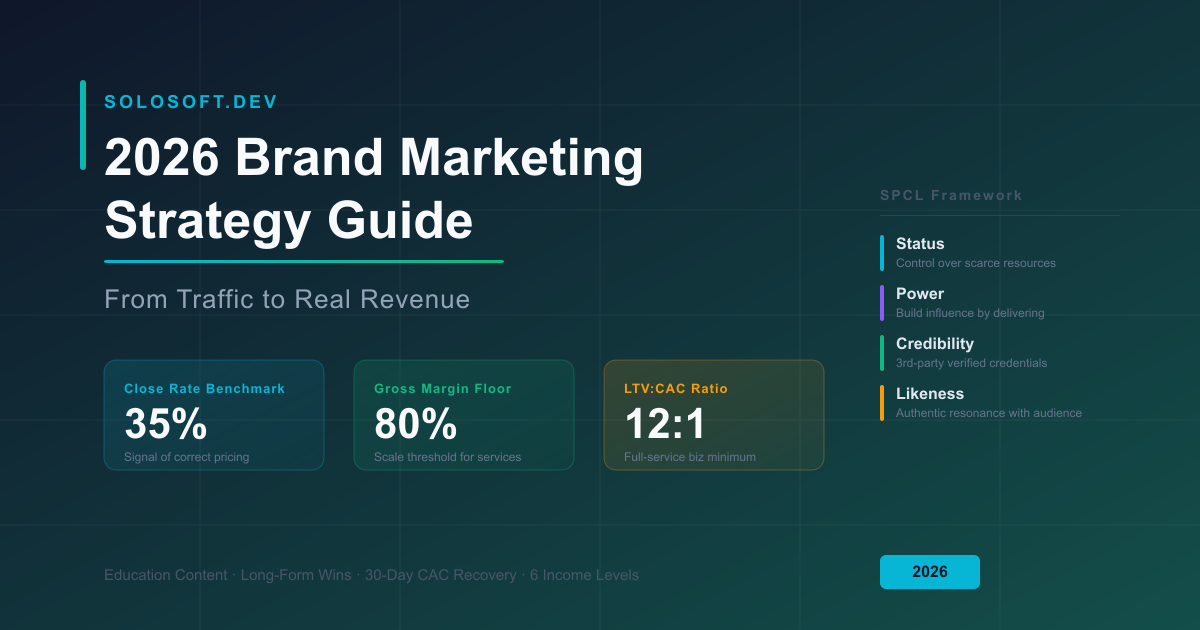
SPCL represents the four pillars of brand influence — Status, Power, Credibility, and Likeness. Combined, they build the kind of authority that makes your audience more likely to say yes to any request you make.
A brand is: “the deliberate pairing of your business with the outcomes your clients want.” SPCL is how you systematically build that pairing:
flowchart LR
    A[Your Brand] --> B[Status<br>Authority]
    A --> C[Power<br>Walk the Talk]
    A --> D[Credibility<br>Proof]
    A --> E[Likeness<br>Resonance]
    B --> F[Maximum Influence]
    C --> F
    D --> F
E --> F| Element | Definition | Practical Application |
|---|---|---|
| Status | Demonstrate control over scarce resources others want | Share real results, revenue numbers, client wins |
| Power | Give advice → audience acts → gets results → builds influence | Provide specific actionable guidance, showcase outcomes |
| Credibility | Third-party verified objective achievements | Actual revenue data, media coverage, industry credentials |
| Likeness | Be authentically yourself, find resonance | Share your real opinions, values, and personal stories |
Key reminder: Never assume your audience knows you. Every interaction should open with the Proof, Promise, Plan framework — establish your credentials, promise what they will learn, and outline the steps to get them there.
How Do You Use “Proof, Promise, Plan” to Build Audience Trust Quickly?
PPP is a three-part opening structure: show verifiable results (Proof), promise specific value (Promise), and outline the path to that value (Plan). Apply this to every new audience encounter — answer the three questions in their mind: “Are you qualified? What do I get? How long will it take?”
Here is the framework in action:
Proof: “Over the past 18 months, I used this system to help 47 clients raise their close rate from 15% to 35%, generating $250,000 in new revenue.” Promise: “Today I’m sharing the complete framework — including a script you can use tomorrow.” Plan: “We’ll start by diagnosing your close rate problem, build your pricing strategy, then design your sales conversation flow.”
According to HubSpot’s marketing statistics, content that clearly communicates its core value within 8 seconds converts at 2.3× the rate of vague openings.
Why Does Long-Form Content Convert Better Than Short-Form?
Short-form builds brand recognition — it lets strangers know you exist. But real trust and buying decisions happen through deep, extended interaction. An unedited 3-hour live stream builds more genuine influence than 100 polished short clips.
Think of it like a relationship: short-form is the first meeting at a party where you make a decent impression. But purchasing a premium product requires the trust equivalent of “six months of getting to know each other deeply.”
| Content Format | Primary Function | Trust Depth | Conversion Potential |
|---|---|---|---|
| Short-form (under 60 sec) | Brand recognition, reach | Low | Low–Medium |
| Mid-form video (10–30 min) | Education, showcase expertise | Medium–High | High |
| Long-form video (60+ min) | Deep trust, paid conversion | Very High | Very High |
| Unedited live stream or podcast | Relationship building, community | Highest | Highest |
According to Sprout Social’s social media statistics, average audience retention on long-form content is 5× higher than short-form, and CTA click rates at the end of long videos are 40% higher.
Three advantages of unedited live content:
- Unfiltered authenticity — audiences experience your actual thinking process, dramatically increasing trust
- Real-time interaction — builds personal connection and deep loyalty
- Positive reinforcement loops — every interaction strengthens audience trust in your brand
Is Your Pricing Right? Diagnose It With Your Close Rate
A 35% close rate is the golden benchmark for correct pricing. If your close rate exceeds 80%, your price is likely 3 to 4 times too low — you are hemorrhaging profit that should be yours.
Here is the truth most founders refuse to face: a very high close rate is bad news.
The higher your close rate, the more your offer feels like “too easy to say yes to” — and pricing that is too easy to accept is almost always far below your real market value.
| Close Rate | Diagnosis | Recommended Action |
|---|---|---|
| Over 80% | Price is 3–4× too low | Raise immediately, test market tolerance |
| 60%–80% | Price is 2–3× too low | Raise in stages, reinforce value communication |
| 35%–60% | Pricing is approximately right | Optimize sales process and persuasion |
| 35% | Perfect pricing benchmark | Hold, keep improving close skills |
| Below 20% | Pricing or pre-sale education issue | Audit whether your pre-sale education is strong enough |
LTV:CAC and Gross Margin: Can Your Business Actually Scale?
Service businesses need a gross margin of at least 80%, and your required LTV:CAC ratio depends on how many human-touch layers your business has. These two numbers determine whether your business can scale — nothing else matters more.
Most business owners focus on revenue. But what determines whether you survive and grow is gross margin and acquisition efficiency.
LTV:CAC Ratio Reference Table:
| Business Model | Human-Touch Layers | Minimum LTV:CAC |
|---|---|---|
| Pure SaaS or fully automated | 0 | 3:1 |
| Live sales + automated delivery | 1 | 6:1 |
| Live sales + live delivery | 2 | 9:1 |
| Live acquisition + live sales + live delivery | 3 | 12:1 |
Gross margin formula:
- Gross Margin = (Revenue − Direct Costs) ÷ Revenue
- Service business floor: 80%
- Target: 80% gross margin → 30% overhead → 50% net profit
Below 80% gross margin, you run out of capital before you can scale.
The 30-Day Payback Rule: Your goal is to recover all acquisition costs (CAC) and delivery costs within 30 days. Use credit card float to achieve this — it is the lever for unlimited expansion.
flowchart TD
    A[Create Educational Content] --> B[Build High-Intent Audience List]
    B --> C[Open with PPP Framework]
    C --> D[Give Away Market-Disrupting Value Free]
    D --> E[Convert Qualified Paying Customers]
    E --> F[Reach Optimal Pricing Close Rate]
    F --> G[Recover Acquisition Costs in 30 Days]
    G --> H[Maintain 80 Percent Gross Margin]
The Six Levels of Making Money: Where Are You Right Now?
From employment to platform, the six levels represent six different mental models. The higher the level, the more leverage you use instead of time. Knowing your level is the first step to designing the right next move.
| Level | Model | Core Asset | Income Ceiling |
|---|---|---|---|
| 1. Employee | Trade time for salary | Personal skills | Salary cap |
| 2. Freelancer | Trade skills for hourly rate | Personal brand | Time cap |
| 3. Service business | Manage others’ time | Processes and team | Headcount cap |
| 4. Productized service | Standardized delivery | Systems and SOPs | Medium–High |
| 5. Digital products or SaaS | Build once, sell forever | Content and code | High |
| 6. Platform or investment | Compound capital and influence | Brand and capital | Near unlimited |
Most people are stuck at levels 1–2 because they do not know how to jump. The critical leap from level 2 to level 3 is learning to systematize your knowledge so that others can replicate your results — not just you personally.
How Do You Recover Your Acquisition Cost Within 30 Days?
Design front-end offer incentives (discounts, priority access, dedicated support) that get clients to pay in their first month. Make cash flow cycle faster than cost consumption, enabling unlimited expansion without external funding.
The 30-day payback logic uses credit card float:
- Run ads on a credit card — get 30–60 days of interest-free runway
- Convert clients within 30 days — first payment received
- Clear the credit card before the bill — one acquisition cycle completed at zero capital cost
- Repeat and scale — monthly acquisition budget can double without outside financing
Businesses rarely die from lack of effort. They die because cash flow breaks at the wrong moment. Cash flow design matters more than revenue numbers.
FAQ
What is the most effective content marketing strategy in 2026?
The most effective strategy in 2026 is pure educational content. The people who buy are those who came to solve a problem. Shift your core metric from view counts to RPM or qualified list size — that is what drives real revenue, not viral exposure.
How does the SPCL framework help with brand growth?
SPCL (Status, Power, Credibility, Likeness) is the four-pillar system for building brand influence. Demonstrate control over scarce resources, let your audience act on your advice and succeed, provide third-party verified achievements, and be authentically yourself. Together these four elements make your audience more likely to say yes.
How do I know if my pricing is correct?
Use your close rate: 35% is the golden benchmark. Over 80% means you are underpriced by 3 to 4 times; 60%–80% means underpriced by 2 to 3 times. A high close rate looks good but means you are leaving substantial profit behind.
What gross margin does a service business need?
A service business needs at least 80% gross margin. You need that remaining margin after direct costs to fund marketing and overhead, ultimately achieving a 50% net profit target. Below 80%, you exhaust capital before you can scale.
What LTV:CAC ratio is needed to scale safely?
It depends on human-touch layers: pure SaaS needs 3:1; one human-touch layer needs 6:1; two layers need 9:1; if acquisition, sales, and delivery are all human-operated, you need 12:1 to safely handle staff turnover and expansion.
Why is it important to recover acquisition cost within 30 days?
The 30-day payback period lets you use credit card float for cash management, enabling unlimited scale without external funding. Cash flow failure is one of the most common causes of business death — designing fast payback periods is a core survival mechanism.
How do you transition from short-form to a long-form content strategy?
Use a “repurposing strategy”: produce one complete long-form video (30+ minutes), then clip highlight moments for short-form distribution. Short-form drives top-of-funnel awareness; long-form builds the trust that converts. They complement each other rather than compete.