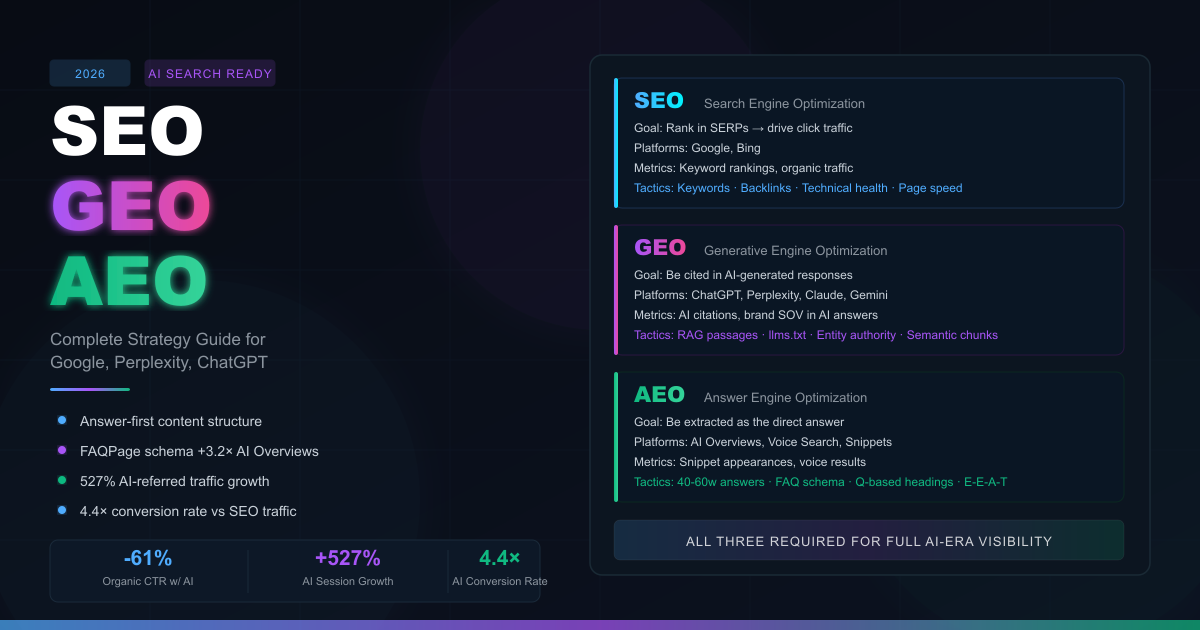
In early 2026, a search behavior shift that analysts had been predicting for years finally arrived at scale. ChatGPT surpassed 800 million weekly active users. Perplexity processes over 780 million queries every month. Google AI Overviews now appear in more than half of all searches — and organic click-through rates on those queries have plummeted 61%. For the first time in two decades, ranking at the top of Google’s blue-link results is no longer sufficient to guarantee visibility.
This is the new reality that three overlapping disciplines — SEO, GEO, and AEO — are racing to address. Understanding where they converge, where they differ, and how to execute all three is the central challenge facing every content team, marketer, and solo creator in 2026.
The shift is not entirely bad news. Yes, up to 69% of Google queries now end without a click. But AI-referred web sessions surged 527% year-over-year in 2025, and the visitors who arrive from an LLM citation convert at 4.4 times the rate of traditional search traffic. AI search rewards depth, authority, and structure — the same qualities that define genuinely good content. The brands that win in this environment will be those who optimize for both the legacy web and the AI-first future simultaneously.
This guide explains how to do exactly that. We cover what each discipline means, how they differ mechanically, the highest-leverage tactics for each, and the technical infrastructure — from schema markup to llms.txt — that ties everything together.
What Is the Difference Between SEO, AEO, and GEO in 2026?
Answer Capsule: SEO optimizes web pages for keyword rankings in traditional SERPs. GEO engineers content at the passage level so generative AI systems cite it in synthesized responses. AEO bridges them by structuring content as machine-extractable direct answers for featured snippets, voice search, and AI answer boxes — with execution tactics nearly identical to GEO.
The alphabet soup of AI search terminology can be confusing. Here is a precise breakdown:
| Discipline | Full Name | Primary Goal | Target Platforms | Key Success Metric |
|---|---|---|---|---|
| SEO | Search Engine Optimization | Rank high in SERPs, drive click traffic | Google, Bing | Keyword rankings, organic traffic |
| AEO | Answer Engine Optimization | Be extracted as the direct answer | Google Snippets, Alexa, AI Overviews | Snippet appearances, voice results |
| GEO | Generative Engine Optimization | Be cited in AI-generated responses | ChatGPT, Perplexity, Claude, Gemini | AI citations, brand SOV in AI answers |
| LLMO | Large Language Model Optimization | Be understood and cited by LLMs | ChatGPT, Gemini, Claude | Cross-platform citation rate |
In practice, AEO and GEO share nearly identical execution tactics: both require answer-first content structure, schema markup, question-based headings, and semantic chunking. The distinction is mostly in measurement: AEO tracks appearances in featured snippets and voice results; GEO tracks citations in generative AI responses across platforms like Perplexity and ChatGPT.
Why Is AI Search Transforming the Industry in 2026?
Answer Capsule: ChatGPT’s 800M weekly users, Perplexity’s 780M monthly queries, and AI Overviews appearing in 50%+ of Google searches have collapsed traditional organic CTR by 61%. Gartner projects a 20–50% organic traffic decline for SEO-only brands by 2028. However, AI-referred sessions convert 4.4x better — making AI citation a premium visibility channel despite zero-click pressures.
The numbers that every content team needs to understand:
| Metric | Figure | Source |
|---|---|---|
| ChatGPT weekly active users (late 2025) | 800 million | OpenAI |
| Perplexity monthly queries | 780 million | Perplexity AI |
| Google queries showing AI Overviews | 50%+ | |
| Organic CTR drop on AI Overview queries | -61% | Industry research |
| Paid CTR drop on AI Overview queries | -68% | Industry research |
| Zero-click Google queries | 60–69% | Industry research |
| AI-referred session growth (2024→2025) | +527% YoY | Industry research |
| AI visitor conversion rate vs. traditional search | 4.4× higher | Industry research |
| Projected organic traffic decline by 2026–2028 | 20–50% (SEO-only brands) | Gartner |
The strategic implication: SEO alone is a declining asset. GEO and AEO are not replacements — they are essential extensions of the same goal: ensuring your brand appears when people search for answers in your domain.
How Does GEO Work? Optimizing for ChatGPT, Perplexity, and Claude
Answer Capsule: GEO shifts content engineering from page-level keyword optimization to passage-level semantic relevance. Each section must function as a standalone, machine-readable unit that an AI retrieval system can extract, evaluate, and cite without needing surrounding context. The core mechanism is Retrieval-Augmented Generation (RAG), which prioritizes factual density, self-contained answers, and entity authority.
GEO operates on a fundamentally different mechanism than traditional SEO. Search engines rank pages. Generative AI systems retrieve and synthesize passages — individual text blocks that get scored for relevance, factual density, and citation-worthiness.
The Five GEO Pillars
flowchart TD
    GEO[GEO Strategy] --> P1[Passage-Level<br>Engineering]
    GEO --> P2[Factual Density<br>Statistics every 150-200 words]
    GEO --> P3[Entity Authority<br>Wikipedia presence and brand mentions]
    GEO --> P4[Cross-Platform<br>Citation Building]
    GEO --> P5[Technical Infrastructure<br>llms.txt and Schema]
    P1 --> R1[40-60 word answer blocks<br>per section heading]
    P2 --> R2[Specific numbers, dates<br>and attributed sources]
    P3 --> R3[E-E-A-T signals<br>and knowledge graph presence]
    P4 --> R4[Appear in Perplexity<br>ChatGPT and Gemini]
    P5 --> R5[Machine-readable content<br>signals for AI crawlers]
1. Semantic chunking — Break content into self-contained logical units. Every H2 section must answer its heading fully without requiring the reader to reference earlier sections. AI engines extract individual passages, not full articles.
2. Answer-first structure — Place a 40–60 word answer block immediately after each heading. This “inverted pyramid” approach gives AI models a high-confidence extractable unit. Perplexity’s Sonar models specifically scan for these snippets to cite with your URL as the source.
3. Factual density — Include specific statistics, dates, and quantified claims every 150–200 words. AI engines gravitate toward verifiable, factual content over general statements. Content with original data and unique statistics gets cited significantly more often.
4. Entity authority — Build your brand’s presence in knowledge graphs and public databases. Wikipedia mentions, press coverage, expert attribution, and consistent entity definition across your site all expand the “vector footprint” AI systems use during retrieval.
5. Technical infrastructure — Deploy llms.txt at your domain root and implement JSON-LD schema. These machine-readable signals explicitly tell AI crawlers what your content covers and who created it, reducing interpretive ambiguity.
What Is AEO and How Do I Get Featured in AI Answer Boxes?
Answer Capsule: AEO structures content for extraction into direct answer placements — Google AI Overviews, featured snippets, voice search results, and AI chatbot citations. The five core AEO tactics are: answer-first content (40–60 words per section), question-based H2/H3 headings, FAQPage and HowTo schema, E-E-A-T signals, and structured formats (tables, numbered lists, comparison grids).
AEO Tactic 1 — Answer-First Structure
Position a concise, self-contained answer block at the start of every section. The optimal length is 40–60 words: long enough for complete context, short enough for clean AI extraction. Content with strong self-contained answers earns featured snippet placements more frequently than content that buries the answer mid-section.
Weak: “FAQ schema is very important for AI search visibility.”
Strong: “Pages with FAQPage markup are 3.2x more likely to appear in Google AI Overviews compared to pages without it, according to 2024 GEO research. FAQ schema has one of the highest citation rates among all schema types for AI search visibility.”
AEO Tactic 2 — Question-Based Headings
Voice search queries and AI prompts are conversational. Structure H2 and H3 tags as natural-language questions that match how your audience actually searches:
- Instead of: “Schema Implementation”
- Use: “How do I implement schema markup on my website?”
This structural alignment makes your content inherently suitable for voice search (which is query-structured) and AI answer extraction (which processes question-intent queries).
AEO Tactic 3 — FAQPage and HowTo Schema
sequenceDiagram
    participant User
    participant AI as AI Engine
    participant Schema as Your Schema Markup
    participant Content as Your Content

    User->>AI: Asks conversational question
    AI->>Schema: Reads FAQPage JSON-LD
    Schema->>AI: Returns question-answer pairs with entity labels
    AI->>Content: Extracts self-contained answer block
    Content->>AI: Returns 40-60 word factual answer
    AI->>User: Cites your URL as source in generated response
FAQPage schema explicitly labels question-answer pairs, allowing AI engines to parse them without guessing. Despite this, AirOps research shows FAQ schema appears on only 10.5% of AI-cited pages — a major competitive opportunity.
HowTo schema maps sequential procedural steps. AI engines frequently handle “how do I…” queries and use HowTo markup to extract steps in the correct order.
How Do I Build Technical SEO Infrastructure for AI in 2026?
Answer Capsule: The 2026 AI-ready technical stack requires four layers: llms.txt (declares site structure to AI crawlers), JSON-LD schema (FAQPage, HowTo, Article, Organization), structured content formatting (tables, lists, numbered steps), and E-E-A-T signals (author bios, credentials, expert attribution). Traditional technical SEO — page speed, mobile-friendliness, crawlability — remains foundational.
The llms.txt File
llms.txt is a Markdown file placed at yourdomain.com/llms.txt. Like robots.txt for traditional search, it gives AI crawlers an explicit map of your authoritative pages, topic focus, and preferred entry points. Example structure:
# Your Brand Name
> One-line brand description and primary topic focus.

## Core Pages
- [Topic Guide](https://yourdomain.com/guide/): What this page covers in one sentence.

## Blog
- [Article Title](https://yourdomain.com/post/slug/): One-sentence summary.
Schema Priority Order for 2026
| Schema Type | What It Does | Priority |
|---|---|---|
| FAQPage | Maps Q&A pairs for direct citation | Critical |
| HowTo | Maps procedural steps for “how to” queries | High |
| Article / BlogPosting | Signals publication date, author, topic | High |
| Organization | Anchors brand to a Knowledge Graph entity | High |
| Person / Author | Connects content to credentialed experts | Medium |
| BreadcrumbList | Provides site context and navigation structure | Medium |
| Product | Defines pricing, availability, reviews | Medium (e-commerce) |
E-E-A-T Signals That Matter for AI
Google and AI engines both evaluate Experience, Expertise, Authoritativeness, and Trustworthiness:
- Authored content — Named authors with byline bios, credentials, and links to professional profiles
- Expert quotes — Attribution to named experts increases citation probability significantly
- Outbound links — Links to authoritative primary sources (official docs, academic research, .gov) validate claims
- Regular updates — AI platforms strongly prefer fresh content; set
lastmodand update articles with new data
What Content Formats Get Cited Most by AI Engines?
Answer Capsule: Comparison tables and step-by-step guides have the highest AI citation potential because AI engines extract structured table data directly into answers and how-to format matches procedural query patterns exactly. Original research with unique statistics also performs exceptionally well, as AI systems prioritize content that provides verifiable data that cannot be found elsewhere.
Based on citation pattern analysis, here are content formats ranked by AI citation potential:
| Content Format | Citation Potential | Why |
|---|---|---|
| Comparison tables | Very High | AI extracts structured data directly into answers |
| Step-by-step guides | Very High | Matches “How do I…” query patterns |
| Original research with unique data | Very High | Data that cannot be found elsewhere |
| FAQ-style content | High | Q&A format aligns with AI processing |
| Expert roundups with named sources | High | Multiple credible voices increase confidence |
| Listicles with specific recommendations | High | “Best X for Y” queries are common |
| Case studies with real outcomes | Medium-High | First-hand experience signals authenticity |
| Definitions and glossaries | Medium | Useful for entity queries but competitive |
| Opinion or thought leadership | Medium | Valued when backed by data |
| Promotional product pages | Low | Too promotional; AI prefers third-party evaluations |
How Do I Measure GEO and AEO Success?
Answer Capsule: GEO and AEO require new measurement frameworks beyond keyword rankings and organic traffic. Track AI citation frequency (prompt your target queries in ChatGPT, Perplexity, and Gemini and record citations), AI share of voice vs. competitors in AI responses, zero-click brand mentions, entity presence in Google Knowledge Graph, and conversion rates from AI-referred sessions in your analytics.
| Metric | What to Measure | Tool / Method |
|---|---|---|
| AI citation frequency | How often brand appears in ChatGPT, Perplexity, Gemini | Manual prompting + tracking |
| AI share of voice (SOV) | Brand mentions vs. competitors in AI answers | Brandwatch, Mention, manual |
| Featured snippet appearances | How often content surfaces in Google AI Overviews | Google Search Console |
| Entity Knowledge Graph presence | Whether brand has a Knowledge Panel | Google Search your brand name |
| AI-referred session traffic | Sessions from ChatGPT.com, perplexity.ai, gemini.google.com | Google Analytics |
| AI-referred conversion rate | Revenue / signups from AI referral sessions | Google Analytics |
| Content freshness | % of articles with updated lastmod in last 90 days | Site audit |
FAQ
What is the difference between SEO, AEO, and GEO?
SEO targets keyword rankings in traditional search results to drive click-through traffic. AEO structures content for direct extraction into featured snippets, voice search results, and AI answer boxes. GEO optimizes passage-level content to be cited in generative AI responses from ChatGPT, Perplexity, Claude, and Gemini. In 2026, all three are required simultaneously for full search visibility.
Why is AI search traffic important in 2026?
AI Overviews now appear in over 50% of Google searches, reducing organic CTR by 61%. Despite zero-click growth, AI-referred sessions surged 527% YoY in 2025 and convert at 4.4x the rate of traditional search. Gartner projects a 20–50% organic traffic decline for brands relying solely on traditional SEO by 2028.
What is the most important GEO tactic in 2026?
Answer-first structure: a 40–60 word self-contained answer block immediately following each section heading. Perplexity’s Sonar models specifically scan for extractable high-confidence snippets. This single change typically has the highest measurable impact on AI citation frequency.
What schema markup is most effective for AEO?
FAQPage schema is the highest-priority — pages with it are 3.2x more likely to appear in Google AI Overviews, yet it appears on only 10.5% of AI-cited pages. Pair it with HowTo schema for procedural content and Article/Organization schema for E-E-A-T authority signals.
What is llms.txt and should I create one?
Yes. llms.txt is a Markdown file at your domain root that tells AI crawlers which pages are authoritative and what your site covers. It is the 2026 equivalent of robots.txt for generative AI systems and is an increasingly standard GEO technical practice.
How do I measure GEO and AEO success?
Track AI citation frequency by querying target topics in ChatGPT and Perplexity and recording your brand’s appearance. Supplement with Google Analytics data on AI-referred sessions (from chatgpt.com, perplexity.ai, gemini.google.com), featured snippet appearances in Google Search Console, and conversion rates from AI-referred traffic.
What content format gets cited most by AI engines?
Comparison tables (AI extracts structured data directly into answers), step-by-step guides (matches procedural query patterns), and original research with unique statistics (AI prioritizes verifiable, source-citable data). FAQ-style content and expert roundups with named sources also consistently rank among the most-cited formats.
Further Reading
- Google Search Central — AI Overviews Documentation — Official Google guidance on AI Overviews and content visibility
- Schema.org FAQPage Reference — Official schema specification for FAQPage structured data
- Perplexity AI — How Citations Work — Perplexity’s search and citation methodology
- Google E-E-A-T Quality Rater Guidelines — Official guidance on Experience, Expertise, Authoritativeness, and Trustworthiness signals