This is not an ordinary product update; it is a clear industry declaration. When Salesforce announced the infusion of 30 new AI features into Slackbot and positioned it as “the future interface for work,” what it is attempting to do is redefine the very concept of “work” itself. This signifies that the battlefield of enterprise software is shifting from the stacking of functional modules to the proactive understanding and orchestration of workflows by intelligent agents (AI Agents). Slack is no longer just a messaging channel; it is ambitiously striving to become the “prefrontal cortex” of the enterprise digital brain, responsible for decision-making, coordination, and execution. For all collaboration platform players, from Microsoft Teams to Notion, the alarm bells are ringing.
Why Will “Conversation as a Platform” Replace “Application as a Tool”?
Because the next leap in productivity hinges on reducing cognitive load and context-switching costs. Over the past decade, we have witnessed the explosive growth of SaaS tools, but this has been accompanied by information silos and operational complexity. The average employee switches between 9 different applications daily, leading to productivity losses of up to 30%. Slackbot’s transformation is precisely Salesforce’s strategic answer to this pain point: it is no longer a passive chatbot responding to commands but an active workflow coordinator capable of linking CRM, databases, third-party services, and possessing “reusable AI skills.”
The industrial logic behind this is clear. Cloud market growth has shifted from “moving to the cloud” to “using the cloud effectively.” Customers need intelligent solutions that directly deliver business outcomes, not more isolated tools. By deeply integrating Slackbot into its Agentforce platform and CRM core, Salesforce is essentially building an enterprise intelligent operating system with conversation as the entry point. Users describe tasks in natural language (e.g., “create a budget for the new product launch”), and Slackbot can understand intent, retrieve data, generate plans, and even schedule meetings. This liberates users from the mechanical operations of “how to do” to focus on the strategic thinking of “what to do.” I foresee that within the next two years, “completing complex workflows through conversation” will evolve from a flashy feature to a standard expectation for enterprise software.
How Will Slackbot’s “Reusable AI Skills” Disrupt Internal Enterprise Knowledge Management?
It will institutionalize and dynamize tacit knowledge while significantly lowering the barrier to automation. Traditional enterprise knowledge management systems (e.g., Wikis, internal forums) are often static repositories, with huge gaps in the creation, encapsulation, and reuse of knowledge. The “reusable AI skills” library launched by Salesforce is essentially a dynamic, composable “digital skills marketplace.” Employees can encapsulate a successful marketing campaign review process or a complex customer complaint handling SOP into a Slackbot skill. This skill can be invoked with one click by colleagues in other departments, customized with parameters, and automatically executed in similar scenarios.
This brings three fundamental changes:
- Knowledge Assetization: Best practices are no longer dormant documents but automation agents that generate direct value.
- Democratized Development: Business experts, without needing to master programming languages, can create proprietary automation tools through natural language descriptions and simple configurations.
- Network Effects: As the skills library enriches, the stickiness and value of the Slack platform will grow exponentially, forming a powerful ecosystem lock-in.
Take a multinational tech company I’ve been in contact with as an example. Its Asia-Pacific finance team used to spend weeks manually consolidating budget data from subsidiaries across countries. In early testing, they encapsulated this process into a “Regional Budget Consolidation” AI skill. Now, any authorized manager simply needs to input a command in Slack, and Slackbot can retrieve data from various systems, consolidate it into a unified format, and generate an analysis report within minutes. This not only compresses work time from weeks to minutes but also ensures process standardization and auditability.
The table below compares traditional knowledge management with the new AI skill-driven model:
| Dimension | Traditional Knowledge Management (Static Documents) | AI Skill-Driven Management (Dynamic Agents) |
|---|---|---|
| Knowledge Carrier | Documents, Spreadsheets, Presentations | Executable AI Skills, Workflows |
| Access Method | Search, Browse, Read | Natural Language Commands, One-Click Trigger |
| Value Realization | Provides Reference Information, Still Requires Manual Execution | Directly Completes Tasks, Outputs Results |
| Update & Iteration | Manual Revision, Complex Version Management | Skill Parameters are Adjustable, Versions are Traceable and A/B Testable |
| Cross-Department Reuse | Difficult, Requires Significant Customized Interpretation | Easy, Skills Can Be Directly Invoked and Fine-Tuned |
Does the Integration of Model Context Protocol Herald the Arrival of the “AI Agent Network” Era?
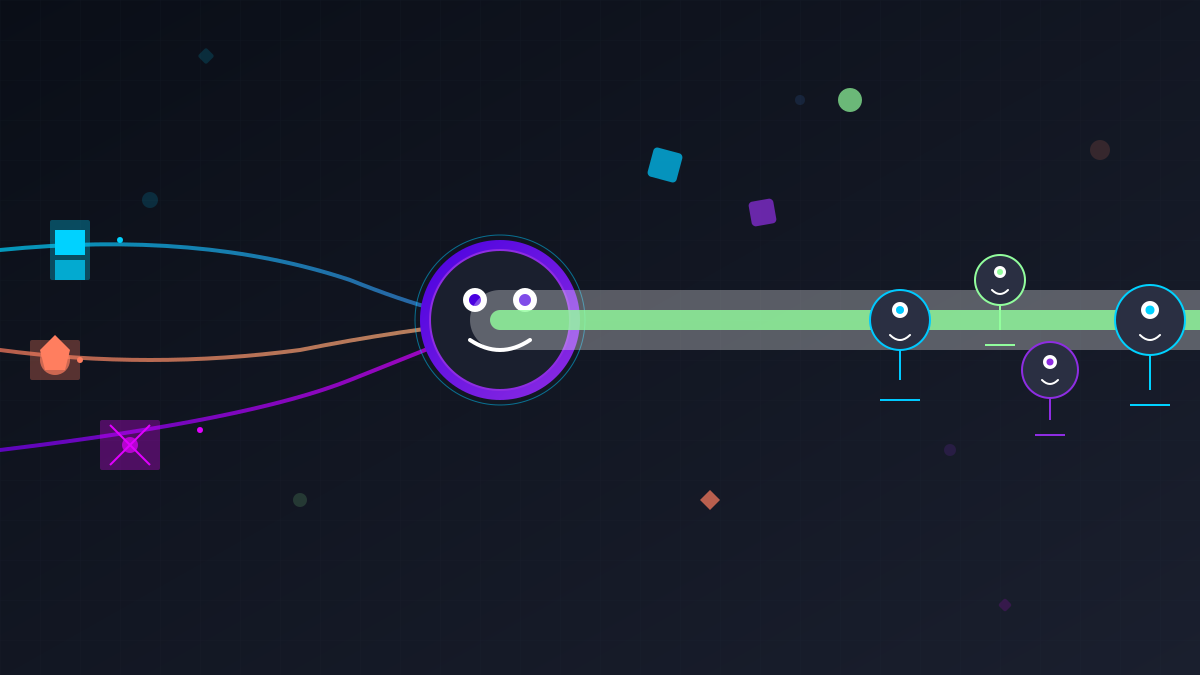
Undoubtedly, yes. This might be the most far-reaching step in this update. Model Context Protocol, as a framework enabling AI agents to connect and use third-party tools, is significant because it breaks the limitations of single AI models. When Slackbot can act as an MCP client and converse with Agentforce and other specialized AI agents, it effectively plays the role of a “commander-in-chief.”
Imagine a scenario: A sales representative asks Slackbot in Slack to handle a critical customer’s technical support escalation request. Slackbot will automatically analyze the request content, then via MCP:
- Invoke the “Customer Sentiment Analysis Agent” to scan the customer’s past interaction records.
- Instruct the “Technical Knowledge Base Agent” to find relevant solutions.
- Dispatch the “Scheduling Agent” to coordinate the most suitable engineer’s time.
- Finally, command the “Document Generation Agent” to draft a report containing all background and solutions, sending it to relevant personnel.
This is a network of multiple specialized agents collaborating, with Slackbot as the user’s sole, unified conversational interface. This marks the transition of enterprise AI applications from “point intelligence” to “system intelligence.” For the industry, the proliferation of protocols like MCP will catalyze a new market: a development and trading platform for specialized AI agents. In the future, enterprises might select AI agents capable of handling specific tasks (e.g., compliance review, creative brainstorming, code review) from a marketplace, much like purchasing SaaS today, and have a hub like Slackbot orchestrate them.
graph TD
    A[Employee Makes Natural Language Request<br>e.g., “Handle Customer X's Complaint Escalation”] --> B[Slackbot as Commander Interface]
    B --> C{Parse Intent & Context}
    C --> D[Invoke CRM Agent<br>Retrieve Full Customer History]
    C --> E[Invoke Sentiment Analysis Agent<br>Assess Urgency]
    C --> F[Invoke Knowledge Base Agent<br>Match Solutions]
    D & E & F --> G[Slackbot Synthesizes Information & Makes Decision]
    G --> H[Dispatch Scheduling Agent<br>Arrange Expert Meeting]
    G --> I[Command Document Agent<br>Generate Report]
    H & I --> J[Report Complete Action Plan<br>to Employee in Slack Channel]
What Threat Does Salesforce’s Move Pose to Microsoft, Google, and Even Startups?
This is a white-hot battle for control of the “enterprise entry point,” and the threat is comprehensive and structural. We must understand that Slackbot’s upgrade is a key step for Salesforce to deeply integrate its CRM data kingdom with the collaboration entry point.
- Direct Confrontation with Microsoft: Microsoft has built a strong moat by bundling Teams with Office 365 and Azure OpenAI. But Salesforce’s strategy is more radical—it directly positions AI as “the work interface” itself, rather than embedding Copilot into existing tools. This is a competition between an “operating system-level” experience and “application-level” features. If Slackbot can truly seamlessly connect end-to-end processes from sales and marketing to customer service, it will directly erode the Dynamics 365 market and challenge Teams’ position as “the place you spend your whole day.”
- Differentiated Strike Against Google Workspace: Google’s strength lies in lightweight collaboration and generative AI (like Gemini) enhancing productivity suites. But Salesforce’s killer feature is “business data context.” Behind Slackbot is a complete customer data platform, giving its AI suggestions and automated actions business-specific relevance, which is difficult for general-purpose productivity tools to match. Google may need to accelerate its enterprise AI agent framework and seek deeper vertical integration opportunities.
- “Dimensionality Reduction Strike” Against Startups: Countless startups are attempting to innovate in single-point workflow automation (e.g., meeting summaries, email drafting, project management). By building these features (like meeting transcription and summarization) into Slackbot and platformizing them, Salesforce directly compresses the survival space for point solutions. Startups must either offer an extreme experience far surpassing the platform’s built-in features or consider how to better “package” their services as an MCP agent that can be invoked within Slackbot, transforming from competitors to ecosystem complements.
The table below summarizes the strategic paths and potential weaknesses of current major players:
| Vendor | Core Strategy | AI Collaboration Focus | Potential Vulnerabilities |
|---|---|---|---|
| Salesforce (Slack) | “Conversation as Workflow”: CRM data as the core, Slack as the unified interface, AI agents orchestrate entire business processes. | Slackbot as the intelligent work bus. | Relatively closed ecosystem; depth and cost of integration with non-Salesforce data sources. |
| Microsoft | “Copilot Everywhere”: Deeply embeds AI assistants into existing product matrix like Teams, Office, Windows. | Copilot in Teams as a productivity-enhancing co-pilot. | May be constrained by the mindset of “enhancing existing tools,” lacking sufficient disruptiveness in reshaping work models. |
| “AI-Native Workspace”: Rebuilds tools like Docs, Sheets as collaborative intelligent entities based on Gemini. | Provides contextual AI assistance throughout Workspace. | Lacks deep vertical business (e.g., CRM) data as fuel for AI decision-making. | |
| Startups | “Single-Point Breakthrough, Experience Wins”: Offers extreme automation experience far surpassing giants in specific work segments. | Focuses on independent AI agents or applications for specific tasks. | Faces survival pressure from being absorbed/crushed by platform-built features or the ecosystem. |
What is the Biggest Trap for Enterprises Adopting This Kind of “Ultimate Work Assistant”?
It’s not technology, but organizational change and the establishment of trust mechanisms. Technically, while connecting APIs and training models pose challenges, solutions always exist. The real deep water lies with people. First, there is the impact on power structures brought by “work transparency.” When Slackbot can automatically summarize meetings, track task progress, and report to stakeholders, the traditional roles of middle managers as “information hubs” and “progress supervisors” will be significantly diminished. Organizations must redefine the value of managers, steering them towards more strategic guidance and decision-making.
Second, there is the issue of “trust” and “accountability” for AI decisions. If Slackbot automatically allocates a budget for a marketing campaign or selects a solution for a customer problem, who is responsible when the outcome falls short? Is it the employee who gave the command, the team that designed the AI skill, or Salesforce? Enterprises need to establish a new governance framework, including processes for reviewing and validating AI skills, transparent traceability of decision logs, and clear delineation of human-machine responsibility boundaries. Blindly pursuing automation while neglecting these soft aspects will lead to project failure or internal conflict.
Finally, the complexity of data privacy and security increases exponentially. An AI agent capable of accessing data across systems and autonomously executing tasks has a much larger attack surface than traditional software. Enterprises must implement the strictest access controls, data encryption, and anomaly behavior monitoring. More critically, they must ensure that AI skills and decisions comply with company compliance policies and ethical standards, which requires deep collaboration between legal, risk control, and IT departments—a management revolution in itself.
In summary, Salesforce’s major upgrade is not merely the release of new features; it is sounding the horn for enterprise digitization to enter the “intelligent agent era.” It forces all participants to consider: Will the future office be organized around intelligent conversational flows, or will it continue to use the application icon arrays of the last era? The answer will determine the power map of the enterprise software market for the next decade. For every knowledge worker, adapting to working alongside “AI colleagues” and learning to “command” rather than merely “operate” digital tools will become an indispensable core competency.