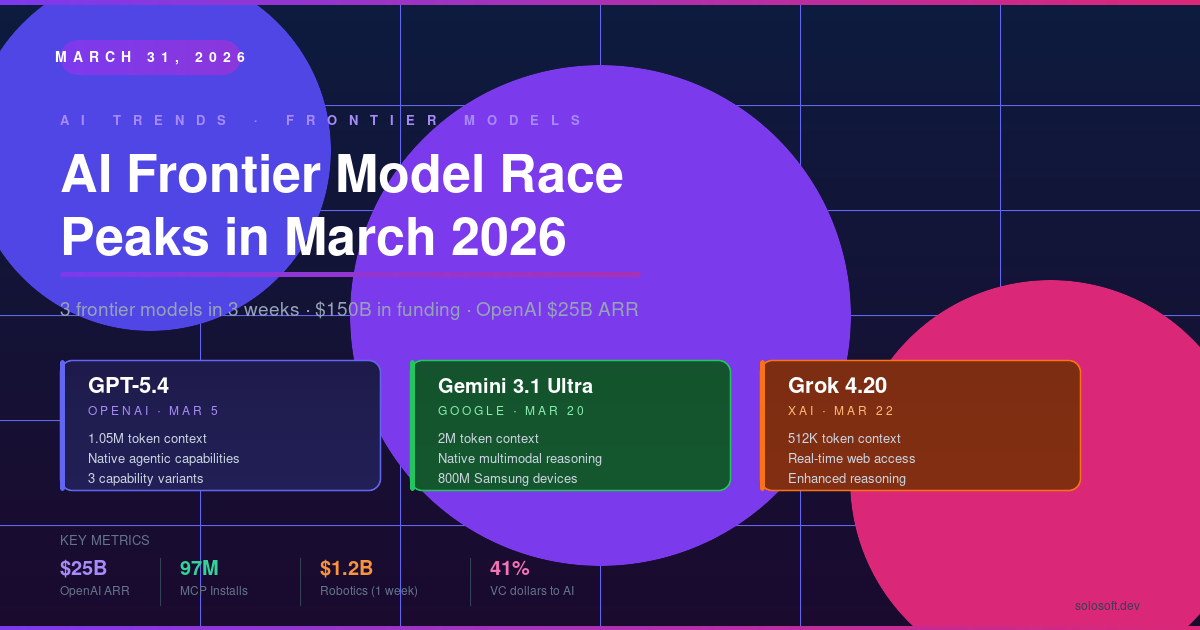
For most of the past four years, the cadence of frontier AI model releases followed a roughly predictable rhythm: major labs would launch one transformative model per quarter, the benchmarks would be parsed, the think-pieces would be written, and the industry would have a few months to absorb the implications before the next release arrived. That rhythm compressed dramatically in March 2026.
In a three-week window between March 5 and March 22, OpenAI shipped GPT-5.4, Google DeepMind released Gemini 3.1 Ultra, and xAI deployed Grok 4.20. Three frontier models from three different organizations, each making credible claims to state-of-the-art performance, each with distinct architectural choices and commercial positioning, arriving in rapid succession. The result was not just a competitive benchmark exercise — it was a structural shift in how the frontier AI race operates and what enterprises, developers, and policymakers must plan for.
The model releases were not the only significant development. OpenAI announced it had exceeded $25 billion in annualized revenue and disclosed IPO intentions. Anthropic is tracking toward $19 billion. The Model Context Protocol crossed 97 million installs, establishing itself as the infrastructure standard for connecting AI to enterprise software. Robotics AI startups raised $1.2 billion in a single week. AI startups accounted for 41% of all venture dollars raised globally in Q1. The month of March 2026 did not just produce more AI news than usual — it produced evidence that the industry has entered a fundamentally different phase of development and commercialization.
This article examines what the March 2026 frontier model releases actually mean, where the AI revenue story is heading, what the infrastructure standardization signals, and why the robotics funding surge deserves more attention than the benchmark debates.
Why Did Three Frontier Models Launch in Under Three Weeks?
The compression of the frontier model release cycle in March 2026 was not accidental. It reflects a competitive dynamic that has been building since the GPT-4 era: the frontier labs are now racing not just on capability but on commercial timing, and the gap between when a model is ready and when it is shipped has narrowed dramatically.
The underlying driver is enterprise contract cycles. Large enterprise customers — the accounts that drive the majority of AI lab revenue — typically finalize annual software procurement in Q1. A lab that misses the Q1 enterprise purchasing window by shipping its flagship model in Q2 or Q3 loses not just a quarter of revenue, but potentially a full year of committed enterprise spend. This creates a structural incentive to compress release timelines toward the January-March window, producing the March 2026 cluster.
| Model | Lab | Release Date | Context Window | Key Differentiator |
|---|---|---|---|---|
| GPT-5.4 | OpenAI | March 5, 2026 | 1.05M tokens | Native agentic capabilities, 3 variants |
| Gemini 3.1 Ultra | Google DeepMind | March 20, 2026 | 2M tokens | Native multimodal reasoning |
| Grok 4.20 | xAI | March 22, 2026 | 512K tokens | Enhanced real-time web access |
The second driver is the maturation of training infrastructure. The capital investments in GPU clusters and training pipelines made in 2024 and 2025 are now delivering trained models simultaneously at multiple labs. The lag between “model is trained” and “model is shipped” has compressed as deployment infrastructure — safety evaluation pipelines, API scaling systems, monitoring tooling — has become more systematized across the industry.
timeline
    title Frontier Model Release Compression 2024 to 2026
    2024 Q1 : GPT-5 Preview
    2024 Q3 : Gemini 2 Ultra
    2025 Q1 : GPT-5.2 and Gemini 3
    2025 Q3 : Claude 4 and Grok 3
    2026 Q1 March 5 : GPT-5.4 Launch
    2026 Q1 March 20 : Gemini 3.1 Ultra
    2026 Q1 March 22 : Grok 4.20
What Does GPT-5.4 Actually Change for Developers and Enterprises?
GPT-5.4’s headline specification — a 1.05 million token context window across three capability variants — is significant, but the more consequential change is architectural. For the first time, an OpenAI flagship model ships with native agentic capabilities that eliminate the need for external orchestration frameworks as a prerequisite for autonomous operation.
Previous enterprise agentic deployments required developers to build or adopt orchestration layers: LangGraph, AutoGen, CrewAI, or proprietary enterprise frameworks. These layers handled task decomposition, tool selection, error recovery, and state management — functions that the underlying models could not reliably perform on their own. GPT-5.4 internalizes much of this orchestration, allowing developers to build agentic applications directly against the model API without an intermediate framework layer.
The practical effect for enterprise deployment timelines is substantial. Projects that previously required three to six months of engineering work to build reliable agentic workflows can now be prototyped in days. This acceleration is already visible in the enterprise adoption data: NVIDIA’s GTC 2026 in March focused entirely on agentic enterprise deployments rather than hardware benchmarks, reflecting customer demand that has shifted from “how powerful is the model?” to “how quickly can we deploy agents in production?”
| Capability | Previous Generation | GPT-5.4 |
|---|---|---|
| Agentic orchestration | External framework required | Native, built-in |
| Context window | 200K tokens | 1.05M tokens |
| Deployment timeline | 3–6 months engineering | Days to prototype |
| Tool integration | Manual API configuration | Dynamic tool discovery |
| Multimodal support | Text and image | Text, image, audio, code |
flowchart LR
    A[Developer Intent] --> B[GPT-5.4 Native Agent]
    B --> C[Task Planning]
    C --> D[Tool Discovery]
    D --> E[API Execution]
    E --> F[Result Verification]
    F -->|Complete| G[Delivered Output]
    F -->|Retry| C
    B --> H[1.05M Token Context]
    B --> I[3 Capability Variants]
How Does Gemini 3.1 Ultra’s Distribution Strategy Differ from OpenAI?
Google’s Gemini 3.1 Ultra, released March 20, represents a fundamentally different competitive strategy than GPT-5.4. Where OpenAI is competing primarily on model capability and API developer experience, Google is competing on distribution — specifically, on the device-level integration that no other frontier model lab can replicate.
The announcement that Samsung will equip 800 million devices with Gemini by year-end represents an installed base that dwarfs the entire paid subscriber count of every AI consumer product combined. When Gemini is the default assistant on hundreds of millions of phones, laptops, and smart devices, the competitive dynamic for consumer and prosumer AI shifts from “which model is best?” to “which model is already there?” — a question Google has historically answered in its own favor.
Gemini 3.1 Ultra’s technical differentiation centers on native multimodal reasoning: the ability to process and reason across text, images, audio, and video within a unified model architecture, rather than routing different modalities through separate specialized systems. The practical advantage for enterprise users is that complex workflows involving diverse media types — a common pattern in marketing, legal, medical, and research contexts — can be handled by a single model API rather than requiring orchestration across multiple specialized models.
| Distribution Channel | Gemini 3.1 Ultra | GPT-5.4 | Grok 4.20 |
|---|---|---|---|
| Enterprise API | Yes | Yes | Yes |
| Consumer app | Google products | ChatGPT | X platform |
| Device OEM integration | 800M Samsung devices | Limited | None |
| Open-weight availability | Partial (Gemma variants) | No | Partial |
Is the Model Context Protocol Becoming the TCP/IP of AI?
The Model Context Protocol reaching 97 million installs in March 2026 is, in many ways, the most consequential development of the month — more consequential for long-term AI infrastructure than any individual model release. The reason is that infrastructure standards compound: once a protocol becomes the default interface layer, it becomes the foundation on which an entire ecosystem builds, creating network effects that are extremely difficult to displace.
MCP’s function is to provide a standardized interface for connecting AI models to external tools, APIs, and data sources. Before MCP, every AI application developer was building custom integration code to connect models to databases, web services, internal APIs, and enterprise software systems. The integration overhead consumed a substantial fraction of AI application development time, and the resulting integrations were brittle, vendor-specific, and difficult to port across model providers.
MCP standardizes this integration layer in the same way that HTTP standardized web communication and SQL standardized database queries. A developer who builds an MCP-compliant tool connector for Salesforce can now use that connector with GPT-5.4, Gemini 3.1 Ultra, and Claude — without rebuilding the integration for each model. For enterprises, this means that the integration investment made for one frontier model is not stranded when a better model becomes available next quarter.
| Infrastructure Standard | Domain | Years to 97M users |
|---|---|---|
| TCP/IP | Internet networking | ~15 years |
| HTTP/HTTPS | Web communication | ~10 years |
| REST APIs | Web services | ~8 years |
| Model Context Protocol | AI tool integration | ~2 years |
The speed of MCP adoption — from introduction to 97 million installs in approximately two years — is a reliable signal that the market has been waiting for this standard. Enterprise developers have been tolerating the integration overhead of proprietary model connectors because no alternative existed. MCP gave them an alternative, and they adopted it rapidly.
What Does the AI Revenue Explosion Reveal About Market Structure?
OpenAI’s $25 billion annualized revenue milestone and Anthropic’s trajectory toward $19 billion reveal something important about how AI commercial markets are structuring: they are consolidating faster and at higher revenue concentrations than most industry analysts predicted two years ago.
The conventional expectation in 2024 was that the frontier model market would remain competitive across five to seven major players, with revenue spread across labs, infrastructure providers, and application developers in roughly proportional shares. What is actually happening is different: two labs — OpenAI and Anthropic — are capturing an extraordinary fraction of direct AI model revenue, while infrastructure (NVIDIA, hyperscalers) captures another large fraction, and the application layer remains highly fragmented.
The revenue concentration at the model layer has implications for the competitive dynamics further down the stack. Enterprise customers are rationalizing their model vendor relationships: rather than experimenting with five different model APIs, they are consolidating on one or two primary providers with MCP-compatible infrastructure to maintain switching flexibility. This rationalization benefits the revenue leaders, creating a self-reinforcing dynamic where revenue concentration drives further adoption, which drives further revenue.
graph TD
    A[AI Revenue Concentration<br>Q1 2026] --> B[Model Layer<br>44B combined ARR]
    A --> C[Infrastructure Layer<br>NVIDIA and hyperscalers]
    A --> D[Application Layer<br>fragmented]
    B --> E[OpenAI<br>25B ARR + IPO plans]
    B --> F[Anthropic<br>19B ARR]
    C --> G[GPU compute<br>1.37T capex 2026]
    C --> H[Cloud AI services<br>Azure OpenAI AWS Bedrock]
    D --> I[1000+ AI startups<br>sub-1B ARR each]
OpenAI’s IPO announcement adds another dimension. A public market listing would give OpenAI permanent access to capital markets, eliminating the fundraising cycles that have required the company to negotiate complex terms with private investors. It would also create the kind of liquidity event that enables the talent retention and competitive compensation necessary to sustain a frontier research organization long-term. Anthropic’s path to the public markets — likely following within 12 to 18 months of an OpenAI IPO — would similarly transform the competitive landscape by giving both companies balance sheet strength that no private challenger can match.
Why Is the Robotics Funding Surge the Most Important Signal Most People Missed?
The $1.2 billion in robotics AI funding raised in a single week in March 2026 attracted less coverage than the frontier model releases, but it may be the more significant leading indicator. The companies involved — Mind Robotics, Rhoda AI, Sunday, and Oxa — are not software companies building AI features. They are building physical AI systems: robots that perceive, reason, and act in the real world.
The investment thesis behind this capital is that AI has progressed to the point where the core capabilities required for general-purpose robotics — perception, planning, manipulation, navigation — are now tractable with frontier model architectures. For the past decade, robotics companies have operated with highly specialized, narrow AI systems for each capability domain. The emergence of multimodal frontier models that can reason across sensory modalities opens the possibility of a different architecture: a single large model that handles perception, planning, and action generation in an integrated system.
| Robotics Sector | Companies | Capital Raised | Application Domain |
|---|---|---|---|
| Household robotics | Rhoda AI | $280M | Home automation and assistance |
| Industrial robotics | Mind Robotics | $350M | Manufacturing and logistics |
| Autonomous vehicles | Oxa | $220M | Commercial vehicle autonomy |
| Agricultural robotics | Sunday | $150M | Precision farming |
The economic implication is significant. Software AI markets, while large, are ultimately bounded by the willingness of organizations to pay for intelligence in digital workflows. Physical AI markets — robotics, autonomous vehicles, precision agriculture, industrial automation — operate in sectors where capital intensity is orders of magnitude higher and labor costs are substantial. If AI-native robots achieve cost and performance parity with human labor in physical tasks, the addressable market expands by an order of magnitude beyond the current AI software opportunity.
FAQ
What made March 2026 a turning point for AI frontier models? March 2026 saw three major frontier models — GPT-5.4, Gemini 3.1 Ultra, and Grok 4.20 — launch within a single three-week window, an unprecedented compression of the competitive release cycle. Combined with record funding activity and OpenAI’s $25B annualized revenue milestone, March 2026 marked the clearest signal yet that the frontier AI race has entered a new, faster phase.
What is special about GPT-5.4 compared to its predecessors? GPT-5.4 ships with a 1.05 million token context window, three capability variants optimized for different use cases, and native agentic capabilities that eliminate the need for external orchestration frameworks. It consolidates the coding strengths of GPT-5.3-Codex with improved multi-step reasoning, making it the first OpenAI model designed from the ground up for enterprise production deployments rather than research evaluation.
How does Gemini 3.1 Ultra compete with GPT-5.4? Gemini 3.1 Ultra, released March 20, introduces native multimodal reasoning that processes text, images, audio, and video within a unified model architecture rather than through separate specialized modules. Google has also announced integration into Samsung’s 800 million Gemini-equipped devices by year-end, giving it a device-level distribution advantage that no other frontier model currently matches.
What is the Model Context Protocol and why did it reach 97 million installs? The Model Context Protocol (MCP) is a standardized interface that allows AI models to interact with external tools, APIs, and data sources in a consistent, interoperable way. It reached 97 million installs in March 2026 because enterprise developers adopted it as the de facto standard for connecting frontier models to existing software infrastructure, replacing the fragmented ecosystem of proprietary integrations that characterized 2024 and 2025.
How much revenue are leading AI companies generating in 2026? OpenAI exceeded $25 billion in annualized revenue in Q1 2026 and has publicly announced IPO plans, while Anthropic is approaching $19 billion annualized revenue. Combined, the two leading AI labs are on track to generate over $44 billion in annualized revenue — a number that would have seemed implausible as recently as 2024, when the entire generative AI commercial market was estimated at under $5 billion annually.
Why is the robotics funding surge in March 2026 significant? Robotics AI startups raised $1.2 billion in a single week in March 2026, including Mind Robotics, Rhoda AI, Sunday, and Oxa. This concentration of capital signals that investors believe AI’s economic value is moving decisively from purely digital applications to physical world transformation — a transition that, if it unfolds as expected, would represent a market opportunity orders of magnitude larger than software AI alone.
What does the AI frontier model compression mean for enterprises? The compression of the frontier model release cycle — three major models in three weeks — means enterprises face a faster obsolescence curve for their AI infrastructure choices. Organizations that locked into single-vendor model dependencies in 2024 are now navigating rapid capability upgrades, multi-model orchestration requirements, and the need for model-agnostic infrastructure layers like MCP that can absorb new model releases without full re-engineering.