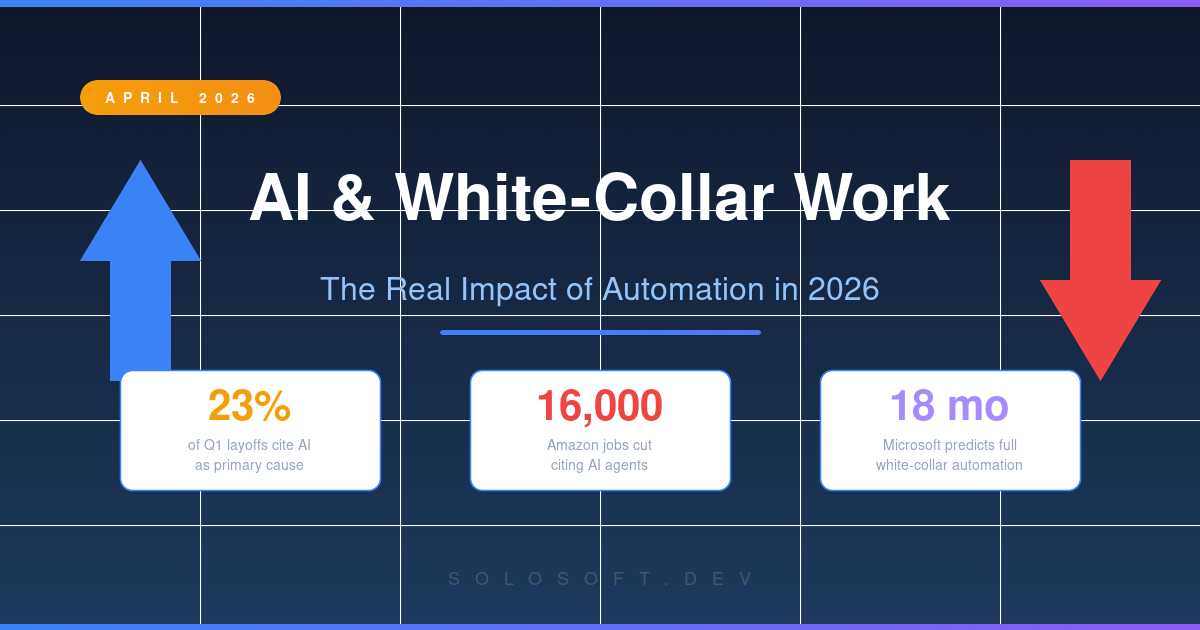
The spring of 2026 has delivered an uncomfortable reality check for office workers across the United States. Amazon, the world’s largest e-commerce company, cut 16,000 corporate employees in January — its biggest single layoff wave ever — and announced a potential second phase of 14,000 more cuts in March, with CEO Andy Jassy explicitly linking the reductions to the deployment of AI agents across the business. Just weeks earlier, Microsoft’s AI chief Mustafa Suleyman made headlines by predicting that all white-collar work could be fully automatable within 18 months. These are not isolated signals: 23% of Q1 2026 corporate layoffs now explicitly cite AI automation or AI-driven restructuring in their SEC filings, up from 14% in Q4 2025. For millions of knowledge workers — analysts, coordinators, paralegals, junior developers, content writers — the question has shifted from will AI change my job to how fast and how much. This article examines the hard data behind the 2026 white-collar disruption wave, identifies which roles face the greatest risk, separates genuine AI displacement from corporate “AI washing,” and offers a practical framework for both individuals and organizations navigating this transition. The evidence is nuanced: AI automation is real and accelerating, but the full-collapse scenarios circulating on social media overstate the near-term picture while distracting from the structural changes already underway.
Is AI Actually Driving the 2026 Layoff Wave?
AI is a genuine and growing factor in workforce reduction decisions — but it is not the only one.
According to data compiled from SEC filings and press releases through Q1 2026, 23% of layoff announcements explicitly mention AI automation as a contributing factor, compared to 14% in Q4 2025. Amazon’s Andy Jassy stated plainly that generative AI and agents “will change the way our work is done” and that the company “will need fewer people doing some of the jobs that are being done today.” Pinterest framed its workforce reductions as a reallocation toward AI systems. Salesforce, JP Morgan Chase, and Ford have made similar forward-looking statements about AI-driven headcount changes.
However, researchers and HR analysts caution against overstating AI’s direct role. Harvard Business Review noted in January 2026 that many companies are laying off workers because of AI’s potential, not its current performance — a form of preemptive restructuring driven by investor expectations as much as operational necessity. Built In’s research found that only 9% of hiring managers say AI has fully replaced certain roles, while 45% say it has partially reduced the need for new hires. The layoff wave reflects a convergence of genuine AI capability gains, cost-cutting pressures, post-pandemic workforce normalization, and market narratives about AI efficiency — not a single clean cause.
| Layoff Driver | % of Q1 2026 Layoffs Citing This Factor |
|---|---|
| AI automation or restructuring | 23% |
| Economic slowdown / cost optimization | 48% |
| Post-pandemic workforce normalization | 19% |
| Strategic business pivot | 10% |
Which Roles Are Most Vulnerable to AI Automation?
Entry-level knowledge workers and highly routinized roles face the greatest near-term displacement risk.
Research from CNBC and multiple labor economists identifies software development (specifically junior and entry-level), customer service, legal document review, financial data analysis, and content writing as the highest-risk categories. The pattern is consistent: AI is eliminating the bottom rungs of the career ladder first — the junior analyst, the first-year associate, the entry-level developer — before moving up the hierarchy. This creates a structural problem for career development pipelines, since those entry roles traditionally provide the experience base for senior positions.
mindmap
  root(AI Automation Risk by Role)
    High Risk
      Junior Software Developer
      Document Review Paralegal
      Data Entry Analyst
      Customer Service Rep
      Content Summarizer
    Medium Risk
      Mid-level Financial Analyst
      Project Coordinator
      HR Generalist
      Technical Writer
    Lower Risk
      Senior Strategy Lead
      Client Relationship Manager
      Creative Director
Executive Decision Maker| Role Category | Automation Risk Level | Primary AI Capability Replacing Tasks |
|---|---|---|
| Junior software developer | High | Code generation, bug fixing, test writing |
| Document review / paralegal | High | NLP document analysis, contract extraction |
| Data analyst (entry level) | High | Automated report generation, data querying |
| Customer service representative | High | Conversational AI agents, ticket resolution |
| Mid-level financial analyst | Medium | Forecasting models, scenario generation |
| Project coordinator | Medium | AI workflow orchestration, status tracking |
| Senior strategy consultant | Lower | Complex judgment, client relationships |
| C-suite executive | Lower | High-stakes decision making, accountability |
What Is “AI Washing” and How Does It Distort the Picture?
AI washing is the practice of attributing layoffs to AI when business or financial factors are equally responsible.
The term has gained traction in 2026 as companies facing investor pressure to demonstrate AI efficiency gains have an incentive to frame workforce reductions as AI-driven transformations. Built In’s investigation found a meaningful gap between executive AI-layoff rhetoric and ground-level HR data: most role eliminations in 2026 remain driven by traditional restructuring logic — overstaffing from pandemic-era hiring, flattening revenue growth, and margin pressure — with AI serving as a convenient narrative. This matters because it shapes public policy, worker retraining investment, and the urgency with which education systems respond to labor market change.
flowchart LR
    A[Company Announces Layoffs] --> B{Primary Driver?}
    B -->|Cost Cutting / Restructuring| C[Framed as AI Efficiency Gain]
    B -->|Genuine AI Deployment| D[Roles Replaced by Agents]
    C --> E[AI Washing Narrative]
    D --> F[Real Workforce Displacement]
    E --> G[Inflated AI Impact Perception]
    F --> G
    G --> H[Policy and Worker Response]
Signs that a layoff announcement may be AI washing rather than genuine displacement:
- The company has not deployed production-ready AI tools in the eliminated departments
- Cuts target middle management rather than highly automatable entry-level roles
- The layoff scale is driven by a post-IPO or earnings pressure cycle
- No corresponding investment in AI infrastructure or retraining is announced
How Are Major Companies Structuring AI-Augmented Workforces?
The leading companies are not simply replacing workers with AI — they are redesigning roles around AI capabilities.
Microsoft, which announced plans to equip every employee with AI agent support by end of 2026, is running over 100 AI agents in its supply chain and is launching Agent 365 in May 2026. Rather than mass layoffs, Microsoft’s model centers on productivity multiplication: one employee augmented by multiple AI agents covering research, analysis, drafting, and coordination tasks. Amazon’s approach is more aggressive, targeting a net reduction in corporate headcount while scaling AI agent deployment across AWS infrastructure, retail operations, and Alexa. Google is pursuing a hybrid model — deploying Gemini 3.1-powered workflows internally while maintaining robust hiring in AI research and engineering. According to Google’s AI Agent Trends 2026 report, 67% of enterprise leaders say they will maintain or increase AI investment even in a recession, suggesting workforce transformation rather than contraction as the dominant long-term pattern.
| Company | AI Workforce Strategy | Headcount Impact |
|---|---|---|
| Amazon | Agent-driven role elimination | -30,000 corporate (phased) |
| Microsoft | AI augmentation for every employee | Neutral to slight reduction |
| AI tooling + continued AI hiring | Net neutral | |
| Salesforce | Agent-first product strategy | Selective role consolidation |
| AI reallocation from human teams | Moderate reduction |
What Should Workers Do Now?
The most defensible workers in an AI-augmented workplace are those who learn to direct and evaluate AI, not compete with it.
Labor economists and workforce development researchers consistently identify a set of durable competencies that AI cannot easily replicate in the near term: complex judgment under uncertainty, stakeholder relationship management, ethical reasoning, creative direction, and cross-functional orchestration. Workers who pair these human competencies with demonstrated AI tool fluency — prompt engineering, workflow automation, output evaluation — become significantly more valuable in the reorganized enterprise. Microsoft, Google, LinkedIn, and Coursera have collectively launched dozens of free or low-cost AI literacy certifications in 2026, making skill development accessible. The key insight from labor market data: AI is not making human judgment obsolete — it is raising the floor for what counts as productive human contribution, which is a meaningful but manageable shift for workers willing to adapt.
FAQ
Is AI actually causing white-collar layoffs in 2026?
Yes, but with nuance. 23% of Q1 2026 layoffs explicitly cited AI automation in SEC filings — up from 14% in Q4 2025. Amazon cut 16,000 roles citing AI agents, and Microsoft’s AI chief predicted all white-collar work could be automated within 18 months. However, experts warn that “AI washing” — using AI as cover for budget cuts — inflates the numbers.
Which white-collar jobs are most at risk from AI automation?
Software development, customer service, paralegal work, financial analysis, and content writing face the highest near-term risk. AI already handles document review, data analysis, report drafting, and code generation. Entry-level and junior roles are being eliminated first, breaking what economists call the “career ladder” for new graduates entering the workforce.
What did Amazon’s CEO say about AI replacing jobs?
Amazon CEO Andy Jassy stated that generative AI and agents will change how work is done, requiring fewer people in some current roles and more in new ones. Amazon cut 16,000 corporate employees in January 2026 — its largest round ever — with a second phase of up to 14,000 more cuts announced in March, targeting middle management and coordination roles most replaceable by AI agents.
What is AI washing in the context of tech layoffs?
AI washing refers to companies citing artificial intelligence as the primary reason for layoffs when economic, strategic, or cost-cutting factors are equally or more responsible. Built In research found only 9% of hiring managers say AI has fully replaced roles, while 45% say it has partially reduced hiring needs. Experts caution that inflated AI-blame narratives distort public understanding of workforce trends.
How should workers prepare for AI-driven workforce changes?
Workers should develop skills that complement AI rather than compete with it: strategic thinking, complex judgment, client relationships, and cross-functional collaboration. Upskilling in AI tool usage, prompt engineering, and workflow automation makes existing roles more defensible. Organizations like Microsoft and Google offer free AI literacy certifications that can significantly boost employability in an AI-augmented workplace.
How quickly could AI automate white-collar work according to tech leaders?
Microsoft AI chief Mustafa Suleyman stated in February 2026 that all white-collar work could be automated within 18 months, though most economists and labor researchers view this as a maximum-scenario projection. Consensus estimates suggest 20–30% of current white-collar tasks will be substantially automated by 2028, with full role elimination being rare outside highly routine, rule-based functions.
Further Reading
- Amazon Layoffs 2026: 16,000 Jobs Cut as AI Push Deepens — ts2.tech
- Companies Are Laying Off Workers Because of AI’s Potential, Not Its Performance — Harvard Business Review
- Microsoft AI Chief: 18 Months to Automate All White-Collar Work — Fortune
- AI Isn’t Causing a Jobs-pocalypse. At Least, Not Yet — CNN Business
- Google AI Agent Trends 2026 Report — Google Cloud