 Build a professional LINE official account with zero code — import one-click templates and let AI boost your marketing!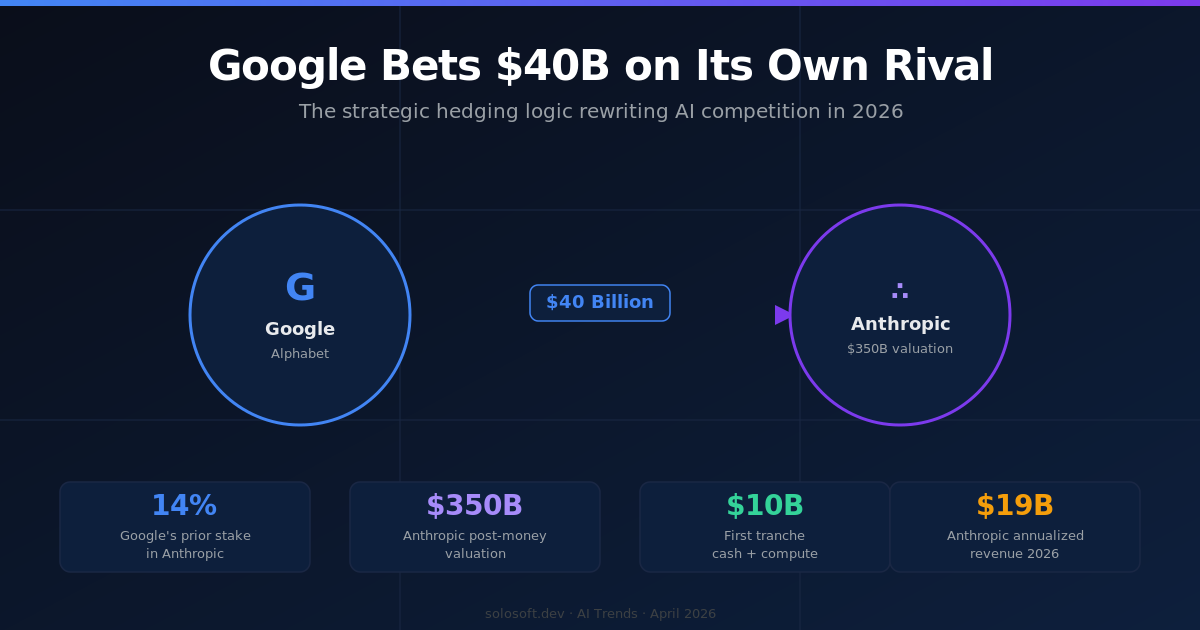
On April 24, 2026, Google confirmed it would invest up to $40 billion in Anthropic — the AI safety company whose Claude models directly compete with Google’s own Gemini family. The deal starts with a $10 billion immediate commitment in cash and compute at a $350 billion Anthropic valuation, with the remaining tranches tied to milestones. Coming just days before Alphabet’s Q1 2026 earnings call, the announcement landed as both a financial statement and a strategic declaration: Google is no longer willing to bet its AI future on Gemini alone.
This is not a minor portfolio move. Google’s prior Anthropic investment exceeded $3 billion, securing roughly a 14% stake since 2023. The new commitment represents a roughly tenfold increase, bringing Google’s total commitment to over $43 billion in a company founded in 2021 by former OpenAI researchers. To put that in context, Google’s entire 2014 acquisition of DeepMind — the deal that gave Google its original frontier AI capabilities — cost approximately $500 million. Anthropic’s implied valuation is now 700 times that figure.
The market read this correctly. Google is not confused about the competitive dynamics. It is running a deliberate parallel strategy: develop Gemini aggressively as the flagship internal model family while ensuring that if Anthropic wins the frontier model race, Google captures a substantial share of that outcome too. It is a hedge that only a company with Alphabet’s balance sheet can execute — and a signal that even the largest tech companies have concluded that no single model bet is safe enough to go unhedged.
For the AI industry, the deal raises harder questions than it answers. When the most well-resourced technology company on Earth invests $40 billion in what it publicly calls a competitor, the word “competitor” stops meaning what it used to.
Why Would Google Invest $40 Billion in a Direct Competitor?
Google’s $40 billion Anthropic investment is a two-part strategic hedge: securing guaranteed AI upside regardless of which frontier model wins, while simultaneously locking Anthropic’s massive compute workloads — hundreds of millions of dollars monthly — to Google Cloud infrastructure rather than allowing them to flow to AWS or Microsoft Azure.
The compute dimension is often underappreciated. Anthropic’s Claude model family runs inference and training at enormous scale. Each new model generation requires petaflop-scale training runs costing hundreds of millions of dollars. Google’s investment comes bundled with preferential compute credits, effectively converting a portion of the $40 billion into pre-purchased GPU capacity on Google Cloud’s TPU and H100 clusters. This is not charity — it is infrastructure lock-in at scale.
flowchart TD
    A[Google strategic rationale] --> B[Hedge model risk<br>own Gemini vs frontier]
    A --> C[Compute lock-in<br>Claude workloads to Google Cloud]
    A --> D[Enterprise channel<br>Google Workspace plus Claude]
    A --> E[Regulatory leverage<br>safety-first narrative]
    B --> F[$40B Anthropic investment]
    C --> F
    D --> F
    E --> F
What Are the Exact Terms of the Deal?
The deal is structured as milestone-gated tranches, not a single lump-sum wire. Google commits $10 billion immediately at a $350 billion Anthropic valuation — matching the February 2026 round price — with subsequent tranches of up to $30 billion releasing as Anthropic hits defined performance and revenue milestones. This structure protects Google against paying full price for a company that fails to grow, while giving Anthropic a credible maximum fundraising number to anchor its market narrative.
| Term | Detail |
|---|---|
| Total commitment | Up to $40 billion |
| First tranche | $10 billion (cash + compute credits) |
| Remaining tranches | Up to $30 billion (milestone-gated) |
| Valuation | $350 billion post-money |
| Google’s prior stake | ~14% (from $3B+ invested since 2023) |
| Deal type | Strategic investment (not acquisition) |
| Announced | April 24, 2026 |
The inclusion of compute credits as part of the investment is structurally novel. Rather than Google writing a pure cash check, a portion of the commitment comes in the form of pre-purchased Google Cloud capacity. This means Google’s actual cash outflow is reduced while Anthropic gets GPU access that is functionally equivalent to cash for a company whose primary bottleneck is compute availability.
How Does This Stack Up Against Amazon’s Anthropic Stake?
Amazon was Anthropic’s first major Big Tech investor, committing $4 billion starting in 2023 and following up with a $2.75 billion tranche in early 2024. That $6.75 billion total — primarily channeled through AWS compute credits and cash — secured Amazon an estimated 20% ownership stake and AWS as Anthropic’s preferred cloud provider for enterprise customer deployments.
Google’s new commitment changes the ownership math dramatically. While exact post-deal percentages have not been publicly disclosed, the scale differential is clear: Google’s committed investment is now roughly six times Amazon’s total, creating a situation where Anthropic’s two largest shareholders are also the two largest cloud infrastructure competitors in the world.
| Investor | Total Commitment | Primary Vehicle | Cloud Benefit |
|---|---|---|---|
| Google (Alphabet) | ~$43B+ | Cash + GCP compute credits | Google Cloud workloads |
| Amazon (AWS) | ~$6.75B | Cash + AWS compute credits | AWS workloads |
| Internal (employees + SAFEs) | ~$2B est. | Equity | N/A |
| Other strategic investors | ~$1.5B est. | Cash | N/A |
The competitive tension between Google and Amazon as co-investors in the same company is unprecedented at this scale in the tech industry. Both companies need Anthropic to succeed — it validates their compute investments — but both companies are also competing fiercely for the enterprise AI cloud contracts that Anthropic helps unlock.
What Does This Signal About the AI Competitive Landscape?
The Google-Anthropic deal is the clearest evidence yet that the frontier AI market has evolved from linear competition into a web of interdependent cross-ownership. The five companies most likely to win the AI model race — OpenAI, Anthropic, Google DeepMind, xAI, and Meta AI — are no longer competing on cleanly separate terms.
OpenAI is backed by Microsoft ($13 billion committed) and recently raised $122 billion in new venture capital at an $852 billion valuation, giving it a war chest that dwarfs any competitor. Anthropic now has Google and Amazon as co-investors, collectively supplying most of its compute. xAI merged with Tesla’s AI operations in February 2026, giving Elon Musk’s AI lab access to Tesla’s Dojo supercomputer and the Colossus cluster. Meta remains the sole major player with no external AI equity investments, operating a closed internal model strategy.
graph LR
    MS[Microsoft] -->|$13B stake| OAI[OpenAI]
    GOOG[Google] -->|$43B+| ANT[Anthropic]
    AMZN[Amazon] -->|$6.75B| ANT
    TSLA[Tesla] -->|Merger| XAI[xAI]
    META[Meta] -->|Internal only| LLAMA[LLaMA models]
    OAI -->|Products| ENT[Enterprise customers]
    ANT -->|Products| ENT
    XAI -->|Products| ENT
    LLAMA -->|Open source| ENT
The map reveals a structural reality: every major frontier AI lab is now financially entangled with at least one cloud or platform giant. This reduces the probability of clean competitive outcomes — winner-take-all scenarios require the losing players to actually lose, but when the largest tech companies hold equity in multiple model families, they profit from every outcome.
Is This Level of AI Investment Concentration Healthy for the Industry?
The concentration is real and the risks are significant. In Q1 2026 alone, AI companies absorbed $242 billion out of a record $300 billion in global venture capital — 81% of all startup investment worldwide. Four companies (OpenAI, Anthropic, xAI, Waymo) accounted for $188 billion, or 65% of all global VC in the quarter. This level of capital concentration in four organizations has no precedent in venture capital history.
| Metric | Q1 2026 | Q1 2025 | Change |
|---|---|---|---|
| Total global VC | $300B | $120B | +150% |
| AI share of VC | 81% ($242B) | 55% | +26pp |
| Top 4 AI rounds | $188B | N/A | — |
| U.S. share of global VC | 83% | 71% | +12pp |
| New AI unicorns | 47 | ~12 | +292% |
The Stanford AI Index 2026 report underscores the structural divide: three-quarters of AI’s economic gains are being captured by just 20% of companies, with the leading organizations focused on growth rather than productivity optimization. For every Anthropic or OpenAI capturing billions in investment, thousands of AI startups are competing for the remaining 19% of AI venture capital — roughly $46 billion spread across the rest of the market.
The counterargument is that concentration is appropriate for an infrastructure-level technology. The development of AI frontier models requires compute, data, and engineering talent at a scale that only the largest organizations can sustain. Google’s $40 billion commitment is, in this reading, not market distortion — it is the rational allocation of capital to a technology whose marginal returns increase with scale. Whether that logic holds long enough to justify the current concentration levels is the question the next three years will answer.
FAQ
Why is Google investing $40 billion in Anthropic? Google views Anthropic as a strategic hedge: if its own Gemini models lose the frontier race, a large Anthropic stake guarantees Alphabet still captures value from the winner. The investment also secures preferential cloud compute deals, locking Anthropic’s massive GPU workloads to Google Cloud rather than AWS or Azure.
What are the terms of Google’s $40 billion Anthropic investment? Google is committing up to $40 billion in multiple tranches, starting with an immediate $10 billion in cash and compute at a $350 billion Anthropic valuation. Subsequent tranches are milestone-contingent. Google had already invested over $3 billion in Anthropic since 2023, holding roughly a 14% stake before this round.
How does Google’s Anthropic investment compare to Amazon’s? Amazon committed roughly $6.75 billion in Anthropic across multiple tranches since 2023, holding an estimated 20% stake. Google’s new $40 billion commitment dwarfs Amazon’s position — but both companies are now co-investors competing for the same enterprise cloud contracts that Anthropic helps unlock.
Does Google’s Anthropic investment conflict with its own Gemini AI? Yes — and that tension is deliberate. Google is developing Gemini as Anthropic’s direct competitor while funding Anthropic’s growth. The logic is portfolio risk management applied to existential technology bets: hedge the outcome regardless of which model family wins the frontier race.
What is Anthropic’s annualized revenue and how fast is it growing? Anthropic is approaching $19 billion in annualized revenue as of April 2026, up from roughly $3 billion at the start of 2025 — approximately 6x growth in 15 months. The growth reflects rapid enterprise adoption of the Claude model family across coding, customer service, and research automation.
What does this deal signal about the future of AI competition? It signals that the frontier AI race has shifted from zero-sum competition to interdependent oligopoly. No single player is confident enough to go all-in on a single model strategy. Instead, every major tech company is building internal AI while funding external AI — creating a web of cross-ownership that blurs competitive lines and concentrates industry power simultaneously.
Is Anthropic still independent after Google’s $40B investment? Anthropic maintains operational independence — its research agenda, safety policies, and product roadmap remain its own. However, with Google and Amazon collectively holding substantial equity and providing the bulk of Anthropic’s compute, true strategic independence is increasingly theoretical. Anthropic’s Public Benefit Corporation structure provides legal guardrails but not absolute insulation from investor influence.