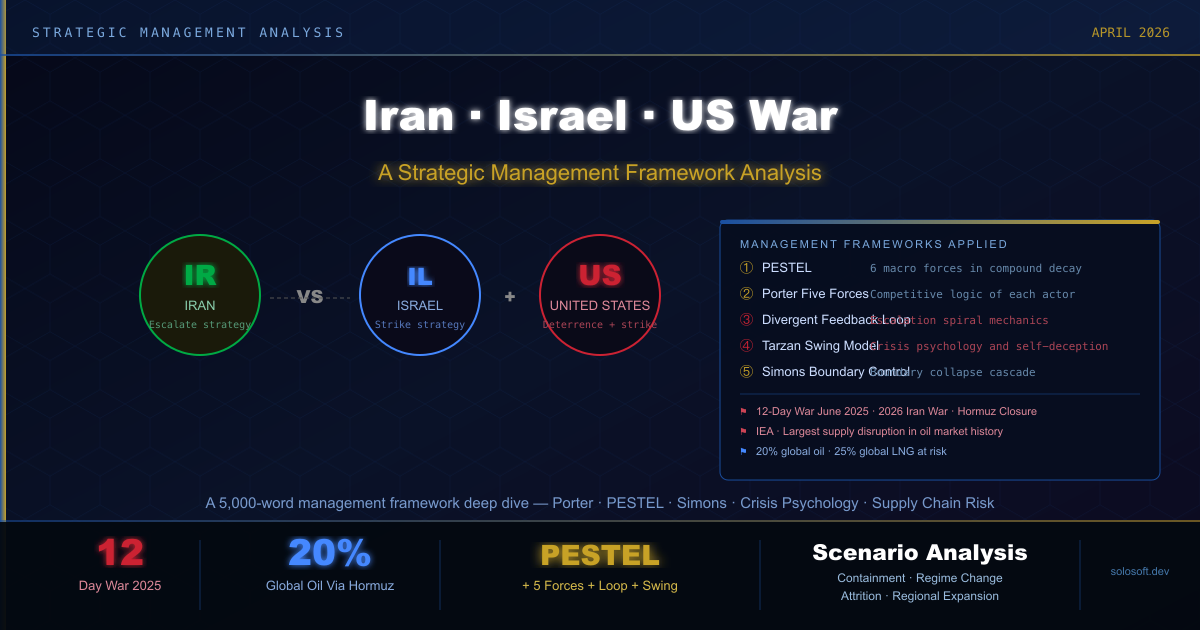
On June 13, 2025, Israeli warplanes executed a meticulously planned strike campaign against Iranian nuclear and military facilities, triggering one of the most consequential geopolitical eruptions of the decade. What followed—twelve days of ballistic exchanges, American airstrikes on Iran’s nuclear program, and a ceasefire brokered by President Trump—was labeled the “12-Day War.” Strategists called it a limited operation. They were wrong about the “limited” part.
Nine months later, on February 28, 2026, the ceasefire shattered. The United States and Israel launched a second wave of strikes with an objective that shattered every previous escalation threshold: the assassination of Supreme Leader Ayatollah Ali Khamenei in Tehran. Iran’s response was total. The Strait of Hormuz — the waterway through which 20 percent of the world’s oil supply passes — was closed. The International Energy Agency declared it “the largest supply disruption in the history of the global oil market.” Oil infrastructure from Kharg Island to a refinery in Haifa burned. Asian manufacturing lines began stalling within days.
This is not simply a story about missiles and warships. It is a case study in strategic management catastrophe: what happens when organizations — whether corporations or nation-states — systematically violate the boundary control frameworks that contain risk, when leaders succumb to the self-deception psychology that Harvard professor Ted Tedlow documented across failed enterprises, and when escalation dynamics enter what systems theorists call a divergent feedback loop from which exit becomes structurally prohibitive.
The management frameworks taught at Tsinghua Business School and Harvard Business School are not only relevant to boardrooms. The same logic that explains Bear Stearns’ 2008 collapse — early warning signals denied, conventional responses that worsened the situation, a cascade of confidence-destroying actions, and a final state where even a powerful intervention could not stop the spiral — explains why a containable conflict became the most dangerous international confrontation in 70 years.
This analysis applies five interlocking management lenses — PESTEL, Porter’s Five Forces, feedback loop dynamics, crisis psychology, and Simons’ Boundary Control System — to decode the Iran-Israel-US conflict. The goal is not to assign blame but to extract structural intelligence that applies to every organization operating in an era of cascading geopolitical risk. The executive takeaways at each section are designed to translate directly into enterprise risk management practice.
What Macro Forces Made This War Structurally Inevitable? A PESTEL Analysis
Answer Capsule: The PESTEL framework — Political, Economic, Social, Technological, Environmental, Legal — reveals that the Iran-Israel-US conflict was not an accident but the convergence of six independently deteriorating environmental forces. No single factor caused the war; it became structurally probable when all six vectors simultaneously pointed toward instability without countervailing institutional mechanisms.
The PESTEL framework is management’s standard tool for auditing the macro environment that constrains an organization’s strategic options. In the management classroom, it is applied to market entry decisions and competitive positioning. In this conflict, it functions as a forensic instrument — a tool for understanding why, at the start of 2026, every macro environmental dimension had simultaneously degraded toward crisis.
Political: The collapse of the 2015 JCPOA nuclear framework left no diplomatic architecture capable of channeling Iranian nuclear ambitions into a stable institutional container. Repeated attempts at US-Iran nuclear negotiations through 2025 — detailed in the Congressional Research Service’s analysis of Iran-Hormuz impacts — ended with Iran’s suspension of talks following the June 2025 Israeli strikes. The political variable had been deteriorating for a decade before the first bomb fell in 2025, and the post-12-Day War negotiation period — despite months of engagement — failed to construct a successor framework. By February 2026, no political architecture remained.
Economic: Iran’s economy, under the accumulated weight of multilateral sanctions, had entered a state that management theorists would describe as resource-constrained strategic desperation — the condition in which an actor perceives limited downside in escalatory action because the status quo is already intolerable. Oxford Economics has assessed the conflict’s economic impact at a potential 0.8–1.2 percent reduction in global GDP if the Strait of Hormuz remained closed for 90 days. But for Iran’s leadership, the economic calculus had already inverted: conflict carried the possibility of breaking the sanctions architecture, while continued compliance offered only slow economic degradation.
Social: Domestic legitimacy pressures inside Iran reached critical levels following years of inflation exceeding 40 percent annually, the women’s rights protest movement, and the perceived humiliation of the 2025 strikes on national territory. For the post-ceasefire Iranian leadership, projecting strategic competence was not merely a tactical preference — it was an organizational survival requirement. The social dimension operated with equal force inside Israel, where three years of existential conflict had hardened public consensus against any settlement perceived as insufficiently guaranteeing security, and inside the United States, where congressional politics created structural pressure for demonstrable action.
Technological: This was the first major interstate conflict in which AI-assisted targeting systems, autonomous drone swarms, and cyber-kinetic hybrid operations were deployed at scale by multiple parties simultaneously. From a risk management perspective, high-tempo AI-assisted operations introduced a critical new failure mode: the compression of decision cycles to a speed that outpaced institutional decision-making and diplomatic response capacity. Where previous conflicts allowed days or weeks for back-channel communication, AI-accelerated targeting cycles measured decision intervals in hours.
Environmental: The Strait of Hormuz had been documented as the world’s single highest-consequence energy supply chokepoint for four decades. Despite this awareness — reflected in Congressional Research Service briefings, IEA energy security analyses, and Goldman Sachs risk research — the global supply chain had built no cost-effective alternative architecture capable of absorbing a full Strait closure. The environmental variable was a known, unmitigated risk that crossed from theoretical to actual the moment Iran acted.
Legal: The February 2026 assassination of Khamenei entered legal territory with no functional international precedent for structured response. Without a legal framework that could channel Iran’s legitimate grievance into institutional mechanisms, the conflict’s resolution defaulted to the only remaining mechanism: force.
| PESTEL Dimension | Pre-War Deterioration Signal | Escalation Contribution |
|---|---|---|
| Political | JCPOA collapse, no successor framework | Critical |
| Economic | Iran sanctions, constrained actor calculus | High |
| Social | Domestic legitimacy crisis on all sides | Moderate |
| Technological | AI targeting, decision cycle compression | High |
| Environmental | Strait of Hormuz unhedged dependency | Critical |
| Legal | No framework for state-level assassination response | Critical |
Management lesson: When multiple PESTEL dimensions deteriorate simultaneously, no single tactical intervention can prevent crisis. The strategic imperative is recognizing compound deterioration — the condition in which reinforcing feedback between dimensions makes the aggregate situation worse than any single dimension alone would predict — and taking institutional action while structural options remain open.
How Do Porter’s Five Forces Explain the Strategic Logic of Three Nations?
Answer Capsule: Porter’s Five Forces — existing rivals, new entrants, substitutes, supplier power, and buyer power — map precisely onto the Iran-Israel-US triad. The framework reveals not just military competition but the structural conditions that made each party’s escalatory choices internally rational even as the system as a whole moved toward catastrophe. Understanding why each party acted rationally within its own framework is prerequisite to designing off-ramps.
Michael Porter’s Five Forces model was built to answer a deceptively simple question: where does competitive pressure come from, and how does it constrain strategic options? Applied to the Iran-Israel-US conflict, the framework reveals the structural logic behind decisions that appeared reckless from the outside but were coherent from within each party’s competitive position.
Force 1 — Competitive Rivalry (Existing Rivals)
The core competitive dynamic pitted Israel and Iran as two regional powers with structurally incompatible survival requirements. For Israel, a nuclear-capable Iran represented an existential threshold beyond which no deterrence architecture could provide adequate security guarantees. For Iran, Israeli strategic supremacy in the region represented a permanent ceiling on influence, security, and regional legitimacy. Both parties were trapped in what game theorists identify as a “hurting stalemate equilibrium” — a situation where both sides pay unsustainable costs but neither can safely exit without guarantees the other cannot credibly provide.
The United States entered as a third party with its own force calculus: the defense of Israel as a treaty and strategic commitment, combined with the imperative to prevent nuclear proliferation. Three parties, each with a non-negotiable core interest, created the maximum possible competitive pressure density.
Force 2 — New Entrants (Proxies and Great Powers)
In Porter’s model, new entrants are parties who previously sat outside the competitive arena but whose entry reshapes it. In this conflict, the new entrants were Iran’s regional proxies — Hezbollah, Houthi forces in Yemen, and Iraqi Shia militias — who threatened to expand a bilateral conflict into a multi-theater regional war. Russia and China, while not military participants, functioned as strategic new entrants by supplying diplomatic cover, intelligence, and material support that raised the effective cost of the US-Israel position.
Force 3 — Substitutes (The Diplomatic Track)
In Porter’s framework, substitutes are alternative ways to satisfy the same strategic need. The substitute for military action in this conflict was the diplomatic track: structured nuclear talks, sanctions relief for verifiable non-proliferation, and a new regional security architecture. The consistent failure to make this substitute credible — due to domestic political constraints on all sides, the absence of binding verification mechanisms, and the September 2025 breakdown of negotiations — progressively eliminated the dampening pressure that substitutes normally provide. When the substitute disappears, rivalry intensifies without bound.
Force 4 — Supplier Power (United States as Strategic Supplier)
The supplier power dynamic operated most visibly in the US-Israel relationship. Israel’s strike capability — F-35 packages, JDAM-guided munitions, satellite intelligence, and real-time targeting data — depended substantially on American supply and operational integration. This created a structural paradox that Ning Xiangdong’s supply chain analysis would recognize immediately: the US was simultaneously the supplier whose capabilities enabled Israel’s strikes and the alliance partner whose strategic interests theoretically governed the scope of those strikes. Supplier power that could have been exercised to moderate Israeli objectives instead became entangled with US domestic political pressures that made objective moderation politically costly.
Force 5 — Buyer Power (Gulf Arab States)
The Arab League’s condemnation of Iranian retaliatory strikes on Gulf Arab states illustrates the buyer power dynamic operating in reverse. Saudi Arabia, UAE, Bahrain, and Kuwait — economies existentially dependent on Strait of Hormuz transit for their primary revenue source — held significant latent leverage over Iran’s escalation calculus. The Arab League Secretary-General explicitly called Iran’s retaliatory strikes “a grave Iranian strategic mistake.” Yet the Gulf states consistently failed to translate this leverage into coordinated pressure on either Iran or the US-Israel coalition at the critical juncture in December 2025 to January 2026, when negotiation was still structurally possible.
| Force | Actor Under Pressure | Mechanism | Strategic Outcome |
|---|---|---|---|
| Competitive Rivalry | Israel vs Iran | Existential mutual threat | Neither side can unilaterally stand down |
| New Entrants | US-Israel coalition | Proxy expansion and great power support | Multi-theater escalation risk |
| Substitutes | All parties | Diplomatic track failure | No institutional off-ramp |
| Supplier Power | Israel from US | Weapons dependency with political constraints | US interests embedded in escalation |
| Buyer Power | Iran from Gulf states | Gulf leverage unused at critical window | Escalation unconstrained by buyers |
Why Did the Conflict Escalate Beyond Any Party’s Intent?
Answer Capsule: Systems dynamics distinguishes convergent feedback loops — where deviations are self-correcting — from divergent loops — where each action amplifies the next. The Iran-Israel-US conflict entered a divergent loop after the June 2025 ceasefire failed to create a sustainable equilibrium. Each retaliatory move increased the perceived political cost of backing down, trapping decision-makers in a structure where rational individual exit was impossible even though all parties would have benefited from collective de-escalation.
In Tsinghua management professor Ning Xiangdong’s analysis of organizational crisis, the most dangerous failure mode is not a single catastrophic decision but the entry into a divergent feedback loop. The professor’s illustration — two strangers trapped in escalating reprisals after a traffic collision, each responding rationally to the last provocation, producing an outcome neither wanted and neither can stop — maps precisely onto the June 2025 to February 2026 interval.
The Iran-Israel-US conflict followed this pattern with textbook precision.
flowchart TD
    A[June 2025 - Israel strikes Iranian nuclear and military sites] --> B[Iran responds with large-scale missile and drone attacks]
    B --> C[US airstrikes destroy Iranian nuclear facilities]
    C --> D[12-Day War ceasefire brokered June 23 2025]
    D --> E[Nuclear negotiations resume but collapse by early 2026]
    E --> F[Feb 28 2026 - US and Israel assassinate Khamenei in Tehran]
    F --> G[Iran closes Strait of Hormuz]
    G --> H[IEA declares largest supply disruption in oil market history]
    H --> I{Feedback Loop Trajectory}
    I -->|Binding diplomatic framework secured| J[Convergent loop - stabilization possible]
    I -->|No binding off-ramp constructed| K[Divergent loop - regional escalation]
After the 12-Day War, a convergent loop was structurally available. Both parties had demonstrated significant military capability; neither had achieved a decisive or irreversible outcome; the ceasefire created an opportunity for a new equilibrium. But convergent loops require active construction: credible institutions, verifiable guarantees, face-saving mechanisms, and enforcement architecture. Without active construction, the natural dynamic of a system under stress is to return to the divergent path.
The collapse of the November 2025 to January 2026 negotiations represented the failure of that construction effort. US negotiators presented demands incompatible with Iranian regime survival; Iranian representatives made commitments their military establishment had no institutional capacity to honor. The negotiation was performative — both sides managing domestic narrative rather than closing a structural gap.
The February 28, 2026 decision to assassinate Khamenei was the inflection point that made a divergent loop structurally locked. The assassination removed the actor with sufficient institutional authority to accept a negotiated settlement on behalf of the regime, and replaced the decision-making structure with a post-succession leadership group whose internal legitimacy required demonstrated ferocity. Iran’s Strait closure was not irrational; it was the logically necessary response of an organization whose existence was now perceived to be at stake.
The Bear Stearns parallel is instructive: by late 2007, the investment bank’s management team could see the housing market was deteriorating. But each conventional response — increased leverage, market confidence statements, internal restructuring — worsened the underlying position, and each worsening raised the political cost within the organization of acknowledging the full extent of the problem. The divergent loop was not the result of stupidity or bad faith; it was the result of rational individual optimization in a system where collective rationality required coordinated action that no individual actor had sufficient incentive to initiate.
The critical intervention point in the Iran-Israel-US conflict was not February 2026. It was the October-to-December 2025 window, when both sides had experienced maximum credible pain without terminal commitment, and a binding framework was still structurally achievable. Organizations that wait for peak-crisis to attempt de-escalation systematically find themselves locked in by the accumulated sunk costs of prior decisions.
What Does the Tarzan Swing Model Reveal About How Leaders Responded?
Answer Capsule: The Tarzan Swing Model describes crisis psychology through four stages — shock and denial, descent into recognized crisis, valley transition, and recovery to new equilibrium. The Iran-Israel-US conflict provides a near-perfect illustration of how leaders at each stage defaulted to self-deception rather than adaptive acceptance, systematically extending the duration and damage of the crisis beyond what the structural situation required.
Harvard Business School professor Ted Tedlow’s research on “self-deception” in organizational leadership — documented in his book of the same name and validated across corporate case studies from General Motors to Kodak — identifies a consistent pattern: when confronted with deeply unwelcome strategic realities, leaders systematically avoid confronting them through a range of cognitive mechanisms that collectively constitute organizational self-deception.
Professor Ning Xiangdong’s Tarzan Swing Model (泰山擺模型) translates this psychology into a four-stage crisis map: the initial “letting go of the branch” (shock and denial), the descent into the valley of acknowledged crisis, the transition at the valley floor where genuine adaptive recalibration occurs or fails, and the upswing to a new equilibrium. The model derives its name from the mental image of a jungle navigator releasing one vine branch and swinging through the low point to grasp the next — with the critical danger being the navigator who refuses to release the old branch, and instead clings to a support that has already left behind.
Stage 1 — Denial (June to September 2025, post-ceasefire): After the 12-Day War ceasefire, both principal parties exhibited the classic denial response. Israel’s leadership characterized the operation as having “disrupted” Iran’s nuclear program — a term that, as CSIS analysts noted explicitly, was chosen to obscure whether the program had been genuinely “dismantled” or merely set back by 12 to 18 months. Iran’s leadership simultaneously claimed strategic victory in propaganda channels while concealing the actual infrastructure damage extent from its own population. Both governments were calibrating their public statements to domestic audiences rather than to strategic reality. Neither side had released the vine.
Stage 2 — Valley Recognition (Autumn 2025, failed negotiations): The November 2025 to January 2026 negotiation period forced partial recognition that the conflict had not resolved its structural drivers — Iran’s nuclear ambitions, Israel’s security requirements, and the absence of a verification architecture. But neither party fully traversed the valley of honest reassessment. US negotiators presented maximalist demands; Iranian counterparts made commitments their military establishment could not honor. The negotiation functioned as a performance of descent rather than an actual descent. Both leaderships were still managing the appearance of strategic competence rather than engaging the strategic reality.
Stage 3 — Catastrophic Self-Deception (February 2026, the assassination decision): The decision to assassinate Khamenei represents the peak expression of the self-deception dynamic in this conflict. In Tedlow’s framework, self-deception becomes most dangerous at precisely the moment leaders have convinced themselves that a maximalist action — taken because conventional options appear exhausted — will produce resolution rather than amplified crisis. The institutional belief that decapitating the Islamic Republic’s supreme leadership would produce either pragmatic capitulation or a successor government more amenable to negotiation reflected a profound misreading of how organizations respond under existential threat. Biological organisms and social organizations alike tend to intensify cohesion and resistance when their existence is perceived as threatened — not to become more flexible.
Stage 4 — Forced Adaptation (March 2026 onwards): The closure of the Strait of Hormuz forced all parties into stage 4: the inescapable recognition that the pre-war strategic framework had been destroyed and that adaptation to a genuinely new equilibrium was unavoidable. This is the Tarzan Swing’s upswing — but it becomes productive only when leaders have honestly traversed stages 2 and 3. Where the transition is forced by external catastrophe rather than leadership insight, the adaptation is typically more costly, slower, and less stable than it would have been if initiated from choice at the valley floor.
For management teams: the interval between stage 1 and stage 4 in any organizational crisis is directly and measurably proportional to the degree of self-deception in stages 2 and 3. Organizations that build systematic mechanisms for interrupting denial early — red team processes, pre-mortem analysis, scenario planning with explicit worst-case scenarios, and board cultures that reward accurate problem-reporting over optimistic narrative — compress the damage period and exit the swing at lower cost.
How Did the Strait of Hormuz Become the Highest-Consequence Supply Chain Risk in Modern History?
Answer Capsule: Global energy supply chains had known the Strait of Hormuz was a critical single-point-of-failure for four decades. But supply chain theory distinguishes knowing a risk exists from having built resilience against it. Iran’s closure revealed that global energy infrastructure had consistently optimized for efficiency rather than resilience, creating a chokepoint that decades of risk assessments had described in detail but failed to hedge at the structural level.
The Li & Fung Group model is management’s canonical example of supply chain architecture optimized for resilience. Li & Fung — described by supply chain theorists as the world’s most sophisticated virtual supply chain operator — owns no physical assets, no manufacturing equipment, no distribution infrastructure. What it owns is the orchestration capability: the ability to manage the entire value chain across hundreds of manufacturing partners globally, substituting any single node in the network when it fails. The architecture is resilient because no single node is irreplaceable.
Global energy supply chains chose the opposite architecture. The Strait of Hormuz is a 33-kilometer-wide passage at its narrowest navigable point. Through it flows 20 percent of global petroleum liquids and approximately 25 percent of global liquefied natural gas, including virtually all of Qatar’s export capacity — the backbone of European and Asian winter heating supply. Despite four decades of documented awareness of this vulnerability — in Congressional Research Service briefings, IEA energy security analyses, Goldman Sachs commodity risk research, and dozens of academic risk assessments — the world had built no cost-effective alternative architecture capable of absorbing a full, sustained Strait closure.
flowchart LR
    A[Global Energy Supply Chain] --> B[Strait of Hormuz<br>20 pct global oil<br>25 pct global LNG]
    A --> C[East-West Pipeline<br>Saudi Arabia bypass<br>5M barrels per day]
    A --> D[Habshan-Fujairah Pipeline<br>UAE bypass<br>1.5M barrels per day]
    B --> E{Strait Status Feb 2026}
    E -->|Open - normal| F[21M barrels per day flows]
    E -->|Closed - Iran action| G[IEA largest supply disruption ever]
    G --> H[Oil infrastructure attacks Kharg Island and Haifa]
    G --> I[Asian manufacturing disruption]
    G --> J[LNG shortage Europe and Japan]
    C --> K[Covers 25 pct of gap only]
    D --> K
    K --> L[No full alternative architecture exists]
When Iran closed the Strait in February 2026, the two existing bypass alternatives — Saudi Arabia’s East-West Pipeline (approximately 5 million barrels per day capacity) and the UAE’s Habshan-Fujairah Pipeline (approximately 1.5 million barrels per day) — could together replace only about 25 percent of the disrupted volume according to Reuters infrastructure analysis. The Soufan Center documented the systematic targeting of energy infrastructure on both sides: attacks on Iran’s Kharg Island primary export facility, refinery attacks in Haifa, and multiple tanker engagements in Hormuz waters. The supply chain was not merely disrupted; it was being actively destroyed.
The supply chain management lesson from this failure is not specific to the energy industry. It is about the structural incentive that consistently produces supply chain fragility across industries: efficiency optimization systematically underinvests in resilience because resilience — redundancy, inventory buffers, alternative supplier relationships — generates cost in normal times and value only in abnormal times. When abnormal times arrive at low frequency and high consequence, organizations have consistently under-reserved against them.
| Supply Chain Risk Factor | Pre-War Assessment | Post-Closure Reality |
|---|---|---|
| Strait of Hormuz dependency | 20% of global oil supply | 20% disrupted simultaneously |
| Bypass pipeline capacity | East-West plus Habshan-Fujairah | 25% of gap covered maximum |
| Oil price threshold | Below $90 per barrel manageable | IEA declares largest disruption in history |
| LNG exposure | Qatar 77% of exports through Hormuz | Severe European and Asian shortage |
| Infrastructure recovery timeline | Weeks if conflict ended quickly | Repairs to damaged facilities measured in months |
| Enterprise impact | Known risk, structurally unhedged | Global manufacturing supply disruption |
For enterprise risk management teams: the Strait of Hormuz is the most visible single-point-of-failure in the global supply chain, but it is not the only one. The discipline of supply chain risk analysis requires identifying, across your entire supplier and logistics network, the nodes whose failure cannot be absorbed by remaining alternatives — and constructing either redundancy, hedging positions, or strategic inventory reserves against each of them before the disruption arrives. The organizations that already had alternative sourcing relationships, strategic energy contracts, and supply chain substitution plans activated fastest when the Strait closed. The organizations that had not built those architectures faced months of reactive adjustment at peak-crisis cost.
What Would Simons’ Boundary Control System Have Prevented?
Answer Capsule: Harvard Business School professor Robert Simons’ Levers of Control framework argues that organizational governance requires four systems: belief systems (core values), boundary systems (explicit limits on action), diagnostic systems (performance metrics), and interactive systems (strategic dialogue). In the Iran-Israel-US conflict, the sequential collapse of boundary systems by all parties — the assassination of a head of state, the closure of a global chokepoint — created a condition where no further boundary was credible to any actor.
Robert Simons built his Boundary Control framework from decades of observing how high-performing organizations maintain discipline under competitive pressure. His central insight is counterintuitive: the value of a boundary system is not that it prevents action but that it creates the conditions under which bold action remains legitimate. Organizations that never establish explicit limits on what they will not do — regardless of tactical advantage — lose the institutional credibility that makes their commitments meaningful to counterparties. Once a counterparty believes you have no real limits, they have no reason to restrain their own behavior in expectation of reciprocity.
In the 12-Day War of June 2025, both sides maintained functional boundary systems under pressure. Israel did not target civilian population centers. The United States confined its role to strikes against nuclear facilities rather than political infrastructure. Iran’s retaliation, while large-scale in missile and drone volume, refrained from closing the Strait of Hormuz and did not target Arab state energy infrastructure. These boundaries were imperfect, contested at the margins, and maintained only partially. But they existed. The June 23, 2025 ceasefire was possible precisely because both parties had preserved sufficient boundary architecture to accept a stopping condition.
The 2026 escalation destroyed these boundaries in sequence:
Boundary violation 1 — Assassination of a head of state: The decision to assassinate Khamenei crossed a threshold that had no established precedent in US-led military operations. In Simons’ framework, this was not merely a tactical escalation; it was a belief-system violation — an action that fundamentally changed what the United States and Israel signaled they were willing to do. Once this boundary was crossed, Iran’s adversaries had no institutional basis for expecting any further constraint on US-Israeli operations. Iran’s own boundary calculus had similarly changed.
Boundary violation 2 — Strait of Hormuz closure: Iran’s closure of the Strait represented the simultaneous destruction of Iran’s most important self-limiting boundary. For decades, Iranian leaders had signaled Hormuz closure as a deterrent threat without ever executing it — precisely because its execution would trigger responses from parties (Gulf Arab states, European powers, Asian economic powers) whose support Iran could not afford to lose. Execution converted a deterrent threat into a demonstrated capability, but at the cost of signaling that Iran had abandoned the constraint that made the deterrent credible without being used.
Cascade effect — Loss of boundary credibility: Once two parties have simultaneously abandoned their primary boundary systems, the multi-party audience — US allies, Gulf states, Russia, China — has no institutional signal that any further boundary is credible to anyone. The loss of boundary credibility is itself a destabilizing event, independent of the physical damage caused by any individual action. It is the organizational equivalent of a governance crisis: the institution that was supposed to enforce the rules has been revealed to have no mechanism for enforcing them.
flowchart LR
    A[Simons Boundary Control System] --> B[Belief System<br>Core strategic values]
    A --> C[Boundary System<br>What we will NOT do]
    A --> D[Diagnostic System<br>Performance indicators]
    A --> E[Interactive System<br>Strategic dialogue]
    C --> F{Boundary Respected?}
    F -->|Yes - June 2025 ceasefire| G[Deterrence maintained<br>Convergent loop possible]
    F -->|No - Khamenei assassination| H[Boundary credibility destroyed]
    H --> I[Iran boundary collapse - Hormuz closure]
    I --> J[All parties lose institutional anchor]
    J --> K[Divergent loop structurally locked]
For Simons, the organizational diagnostic question at the boundary is always: “What is the risk to our core resources — our reputation, our relationships, our institutional survival — if we cross this line?” By February 2026, both parties had answered that question by deciding the risk of not crossing the line was greater. That calculation may have been individually rational. Collectively, it produced a system with no remaining stopping conditions.
For corporate boards: Simons’ framework teaches that boundaries must be established, documented, and enforced in advance of crises — not negotiated in real time under competitive pressure. The organizations that maintain explicit “non-negotiable” constraints on their behavior — through board policy, covenant structures, legal frameworks, or public commitment — preserve their ability to use those constraints as credible signals in high-stakes negotiations. Once you have established a pattern of violating your own limits under sufficient pressure, counterparties rationally discount all future constraints you announce.
What Scenarios Will Determine Whether This Conflict Escalates or Resolves?
Answer Capsule: Strategic scenario analysis identifies four possible trajectories: negotiated containment, Iranian regime change, prolonged attrition, and regional expansion. Each has distinct probability-weighted impacts for global supply chains, enterprise risk exposure, and geopolitical architecture. The outcome depends primarily on whether a binding diplomatic framework with enforcement mechanisms can replace the boundary systems that were successively dismantled through 2025 and 2026.
Scenario planning — developed by Shell in the 1970s as a response to energy market uncertainty — is the management methodology most explicitly designed for Knight’s true uncertainty conditions: situations where probability distributions cannot be meaningfully constructed because the relevant future states are not yet identified, let alone measurable. The Iran-Israel-US conflict is precisely this kind of situation. The following four scenarios define the current strategic option space.
Scenario A — Negotiated Containment A new Iranian leadership group, facing existential threat to the regime and economic catastrophe from the Hormuz closure’s blowback on Gulf Arab state relationships, accepts a face-saving framework that suspends nuclear development in exchange for sanctions relief and credible security guarantees. This scenario requires a US administration willing to offer guarantees it can politically deliver and an Iranian successor leadership whose internal position is strong enough to accept them. It is the most desirable outcome for global stability and the least likely to emerge without active US diplomatic investment.
Scenario B — Regime Change Sustained military pressure, combined with the economic consequences of the Hormuz closure, triggers an internal military coup or widespread popular uprising that removes the Islamic Republic’s current leadership structure. This scenario carries high geopolitical volatility: a post-regime Iran would face significant internal fragmentation, proxy warfare from remaining IRGC factions, and a power vacuum that neighboring states and great powers would immediately seek to fill. “Regime change” is historically more likely to produce prolonged internal conflict than a clean successor state capable of managing inherited commitments.
Scenario C — Prolonged Attrition (Base Case) Neither side achieves decisive outcome. Israel and the US lack the ground force capability and domestic political will for occupation; Iran lacks the military power to expel US and Israeli forces from the theater. The conflict settles into a grinding pattern of periodic strikes, proxy engagements, and intermittent Hormuz disruptions that maintain a permanent elevated risk premium in global energy markets. This scenario is currently assessed as the base case for enterprise risk planning purposes.
Scenario D — Regional Expansion Gulf Arab states, pulled into the conflict by Iranian strikes on their territory or energy infrastructure, enter the war directly or through coordinated proxy engagement. Russia provides Iran with advanced air defense and intelligence in exchange for geopolitical leverage. China, facing economic catastrophe from LNG supply disruption, applies coordinated pressure on the US coalition. This scenario has low probability but catastrophic consequences if triggered, including global recession risk and permanent restructuring of the international energy system.
| Scenario | Trigger Condition | Risk-Weighted Probability | Economic Impact | Supply Chain Impact |
|---|---|---|---|---|
| A - Negotiated Containment | New Iranian leadership accepts framework | Medium-high with active diplomacy | Moderate recovery | Hormuz reopens within 90 days |
| B - Regime Change | Internal coup or uprising | Low-medium | High short-term volatility | Prolonged uncertainty over months |
| C - Prolonged Attrition | No decisive outcome | Medium — base case | Sustained GDP drag globally | Permanent Hormuz risk premium |
| D - Regional Expansion | Gulf states enter directly | Low | Global recession risk | Supply chain structural restructuring |
The game-theoretic framing from Oraclum Research characterizes the current situation as a “screening game”: the US-Israel coalition is testing whether Iran’s post-Khamenei leadership is pragmatic or hardline by applying pressure and observing the response. CSIS analysts characterize Iran’s strategy as “don’t calibrate — escalate,” suggesting the current Iranian leadership has made a deliberate choice to avoid graduated signaling in favor of disproportionate response as a deterrence restoration mechanism.
Enterprise planning implication: Risk managers should treat Scenario C (prolonged attrition) as the base case for planning horizons through the end of 2026, with quarterly scenario review triggers. Scenario A (negotiated containment) should be treated as an upside scenario that requires an observable precondition — specifically, the emergence of verifiable Iranian diplomatic engagement endorsed by the post-Khamenei leadership — before being integrated into operational plans. Scenario D (regional expansion) should anchor the stress test rather than the base case, but requires dedicated contingency planning given the asymmetric downside.
FAQ
What triggered the Iran-Israel-US war in 2025-2026?
The conflict escalated from Israel’s June 2025 “12-Day War” strikes on Iranian nuclear and military sites, which ended in a ceasefire brokered by President Trump. Nine months later, after failed nuclear negotiations, the US and Israel launched a second wave of strikes on February 28, 2026 — with the opening salvo assassinating Supreme Leader Khamenei in Tehran — triggering Iran’s closure of the Strait of Hormuz.
How did the Strait of Hormuz crisis develop?
Iran closed the Strait of Hormuz following the February 2026 assassination of Khamenei. The Strait carries 20 percent of global oil and 25 percent of global LNG. Its closure triggered what the IEA called the largest supply disruption in global oil market history. The two available bypass pipelines — Saudi Arabia’s East-West Pipeline and the UAE’s Habshan-Fujairah Pipeline — cover only about 25 percent of the disrupted volume.
What is a divergent feedback loop in crisis management?
A divergent feedback loop is a systems dynamics condition in which each response to a disruption amplifies rather than dampens the original problem. In the Iran-Israel-US conflict, each retaliatory action raised the political cost of backing down for the responding party, making rational individual exit structurally harder at every step. The pattern is structurally identical to the Bear Stearns collapse spiral in 2008, where each conventional response worsened the underlying condition.
Which management frameworks best explain the conflict?
Five frameworks provide the most analytical leverage: PESTEL (documenting the six macro forces that made conflict structurally probable), Porter’s Five Forces (explaining the competitive logic of each party), divergent feedback loop dynamics (explaining escalation mechanics), the Tarzan Swing Model (documenting the self-deception psychology of crisis leadership), and Simons’ Boundary Control System (explaining how the sequential destruction of behavioral limits made the conflict uncontrollable).
What are the main scenarios for resolution?
Scenario analysis identifies four trajectories: negotiated containment (medium-high probability if new Iranian leadership accepts a face-saving diplomatic framework); Iranian regime change (low-medium probability, high volatility); prolonged attrition as the base case (medium probability, sustained global economic drag); and regional expansion drawing in Gulf states and great powers (low probability, catastrophic if triggered).
How should enterprises manage supply chain risk from this conflict?
Risk managers should treat prolonged attrition as the base case. Immediate actions include auditing Persian Gulf energy supply exposure at every supplier tier, stress-testing against a 90-day Hormuz closure scenario, identifying single-point-of-failure chokepoints in their own supply networks, and building alternative sourcing and logistics routing before they are urgently needed. The organizations that had built supply chain resilience before February 2026 activated substitution plans fastest at lowest cost.
What does Simons’ Boundary Control System teach us about this war?
Simons’ framework holds that organizational governance requires four interlocking systems: belief, boundary, diagnostic, and interactive. The Iran-Israel-US conflict demonstrates that when boundary systems are sequentially destroyed by principal parties — the assassination of a head of state, the closure of a global chokepoint — the resulting loss of boundary credibility is itself destabilizing, independent of physical damage. No subsequent declaration of limits is credible to any party once this pattern is established.
Further Reading
- CFR Global Conflict Tracker — Iran’s War With Israel and the United States — Council on Foreign Relations real-time conflict tracker, including IEA supply disruption assessment and timeline
- CSIS Latest Analysis — War with Iran — Center for Strategic and International Studies comprehensive expert analysis of military, regional, and geopolitical implications
- Wikipedia — 2026 Strait of Hormuz Crisis — Wikipedia overview of the 2026 Strait closure, its causes, the bypass pipeline alternatives, and its impact on global energy supply chains
- Oxford Economics — Economic Impact of the Iran Conflict — Independent macroeconomic assessment of global GDP and supply chain impacts