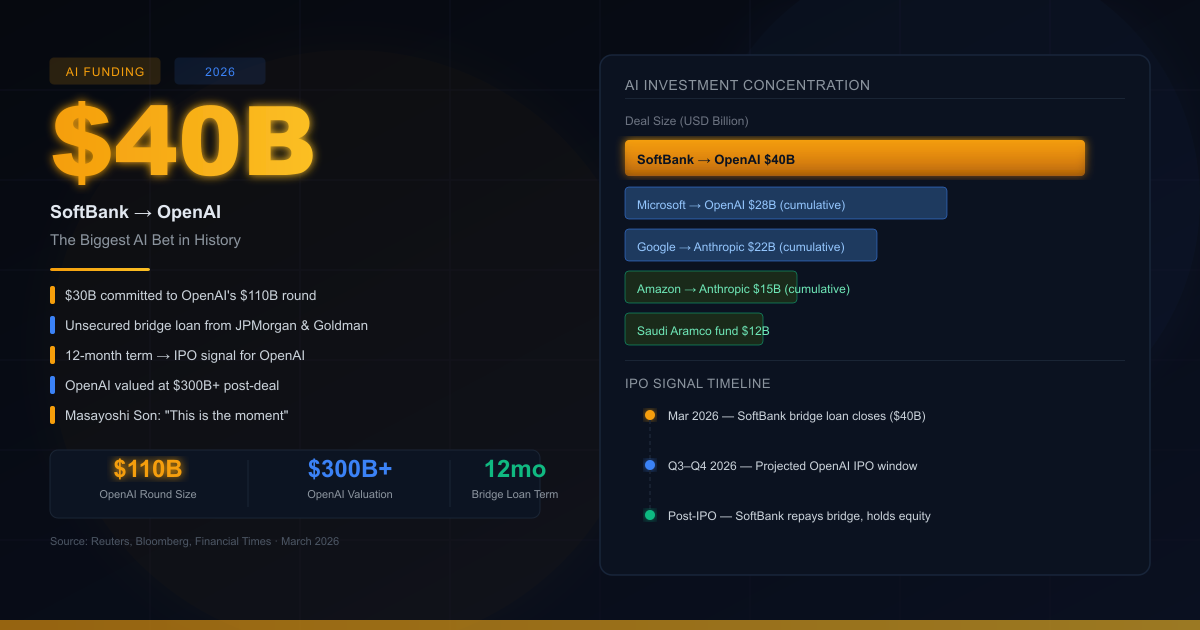
On March 27, 2026, SoftBank Group secured what may be the largest unsecured bridge loan in corporate history — $40 billion — to fund a further $30 billion investment in OpenAI. The lenders include JPMorgan Chase, Goldman Sachs, and four major Japanese banks. By close of trading that same day, SoftBank shares had fallen nearly 45% from their October 2025 highs.
The market’s reaction tells one story. The strategic logic tells another. Understanding both is essential to grasping where AI is heading in 2026.
The Anatomy of a Record Bet
SoftBank’s new commitment brings its total investment in OpenAI to over $60 billion — a figure that exceeds the GDP of several small nations and dwarfs the venture capital deployed by most top-tier firms in an entire year.
The $40 billion loan carries a critical structural detail: it matures in 12 months. Unsecured bridge loans of this size, with such short repayment windows, are not designed for long-term holding. They are designed to be retired with liquidity from a known upcoming event. The most obvious candidate is an OpenAI IPO.
OpenAI’s $110 billion funding round — of which SoftBank’s $30 billion is a part — implies a pre-money valuation approaching $300 billion. If OpenAI goes public at even a modest premium, it would rank among the largest tech IPOs in history, generating enough proceeds to comfortably cover SoftBank’s debt position.
Why SoftBank Is Willing to Strain Its Balance Sheet
Masayoshi Son has a well-documented history of making outsized bets in transformative technology waves. Some, like Alibaba, generated legendary returns. Others, like WeWork, became cautionary tales. The OpenAI bet reads as a thesis refinement: bet on the infrastructure of intelligence itself, not its applications.
The logic runs as follows:
Every application layer eventually competes on the model layer. Whether it is enterprise software, healthcare diagnostics, or autonomous vehicles, competitive advantage increasingly traces back to access to the best foundation models. Owning a large stake in the company that runs the best model is, in theory, owning a toll booth on the entire AI economy.
OpenAI’s revenue trajectory justifies the multiple. OpenAI reportedly crossed $5 billion in annualized revenue in late 2025. If that figure continues on even a modest growth curve, a $300 billion valuation is a 60x revenue multiple — aggressive, but not unprecedented for category-defining platform companies in their high-growth phase.
The 12-month loan signals conviction about timing. SoftBank would not take on $40 billion in unsecured debt unless it had high confidence in a liquidity event within the loan window. That confidence likely comes from information shared in the investment discussions themselves.
The Counterargument: Why the Market Sold Off
SoftBank’s shares falling nearly 45% from peak is not irrational. Markets are pricing in real risks:
- Concentration risk: SoftBank’s single largest position is now illiquid private equity in a pre-IPO company with no guaranteed timeline.
- Debt load: $40 billion in short-term unsecured debt on top of existing SoftBank leverage is a significant financial engineering bet. If an IPO is delayed or markets turn, refinancing costs could be painful.
- Regulatory headwind: The FTC and UK’s CMA are intensifying scrutiny of “circular spending” arrangements — where investors fund AI startups that then spend that capital buying the investors’ own cloud services or chips. The regulatory environment around OpenAI specifically is increasingly complex.
The market selloff reflects a healthy skepticism about whether the risk/reward profile makes sense at this scale, even if the underlying thesis about AI’s trajectory is correct.
The Broader Industry Signal: Capital Consolidation Is Accelerating
The SoftBank/OpenAI deal is not an isolated event. It is the most visible data point in a clear pattern: AI investment capital is concentrating rapidly around a small number of frontier labs.
Consider the current landscape:
| Company | Cumulative External Investment (2024–2026) | Key Investors |
|---|---|---|
| OpenAI | $110B+ | Microsoft, SoftBank, Nvidia, Abu Dhabi |
| Anthropic | $12B+ | Amazon, Google |
| xAI | $6B+ | Strategic investors |
| Mistral | $1.1B+ | General Catalyst, Nvidia |
The gap between the top two tiers is growing faster than the technology gap between them. This has two implications for the broader ecosystem.
For enterprise buyers: The switching costs between frontier models are lower than the switching costs in cloud infrastructure. Today’s pricing and availability advantages can shift quickly. Building deep dependencies on a single model provider carries real lock-in risk.
For AI startups: The “build on top of foundation models” strategy that Y Combinator and others have championed remains viable — but founders need to watch the infrastructure they depend on. As frontier labs expand into application layers (see: OpenAI’s foray into productivity tools, Anthropic’s API partnerships), the surface area of potential conflict grows.
What Founders and Investors Should Watch
Three signals are worth tracking over the next 90 days:
OpenAI IPO filing: If a prospectus is filed in Q2 2026, it validates the entire SoftBank thesis and likely triggers a wave of secondary market re-pricings across the AI ecosystem.
Regulatory outcomes: The FTC’s investigation into circular spending patterns in AI could produce consent decrees that reshape how the largest investors are allowed to participate in the AI supply chain. Watch for any settlements or litigation outcomes involving Microsoft, Amazon, or Nvidia’s positions in OpenAI and Anthropic.
Open-source model parity: Mistral Small 4 (22B parameters) reportedly outperforms closed models three to five times its size on standardized benchmarks. As open-source quality approaches frontier-closed quality, the toll-booth thesis underlying SoftBank’s bet gets harder to defend — because the “best model” may be free.
The Bottom Line
SoftBank’s $40 billion bet on OpenAI is simultaneously a rational calculation about IPO timing and a high-conviction thesis about who will own the infrastructure of the AI economy. The 12-month loan maturity turns it into something closer to a structured pre-IPO position than a traditional venture investment.
Whether it is visionary or reckless depends entirely on two variables: OpenAI’s IPO timeline and whether regulatory pressure reshapes the capital concentration dynamics that make owning a large OpenAI stake so theoretically valuable in the first place.
For the rest of the industry, the signal is clear: the era of “anyone can build a frontier lab” is closing. The question for founders is no longer whether to build on existing foundation models, but which dependencies to accept, which to hedge, and how to maintain strategic optionality as the infrastructure of intelligence consolidates around a very small number of players.