In 2026, the most exciting entrepreneurial wave isn’t the metaverse or another NFT cycle — it’s the opening of a window where a single person can build a million-dollar business.
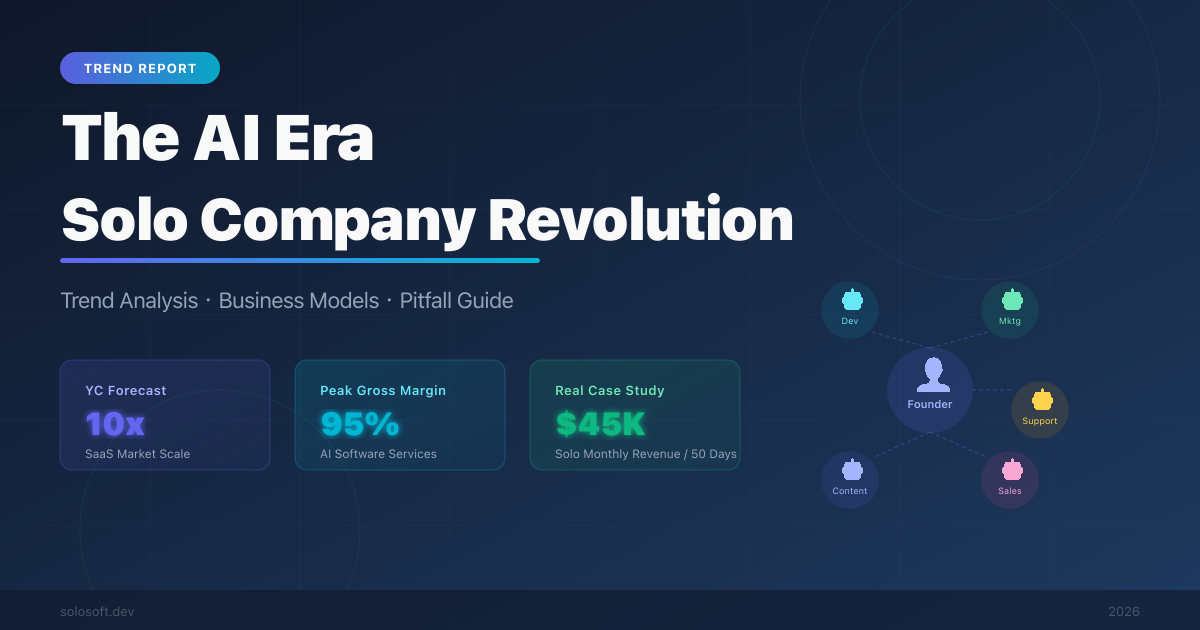
Y Combinator — the accelerator behind Airbnb, Dropbox, and Stripe — has declared that AI-native agencies are the next wealth-creation wave, with a market potential 10 times larger than SaaS. OpenAI CEO Sam Altman went further: “The first billion-dollar one-person company is coming.”
This isn’t hyperbole. Here are three real numbers first:
- 23-year-old Connor, with no programming background, used Claude Code to turn competitor screenshots into a live app. Month 50 revenue: $45,000. Annual run rate now exceeds $2 million.
- AI automation freelancer Chris Lee earns $6,000/month with $20/month in tools.
- Marketer Daojie built 70 Claude AI Agents and drove $1.25 million in client revenue in two months.
But equally real: a solo company is not a “buy tools and get rich” myth. The traps run deep, and most courses won’t warn you about them.
This article draws on 30 first-hand sources — YC reports, real founder case studies, and policy documents — to give you a full picture of the AI-era solo company landscape.
What Is an AI-Era Solo Company? (Q&A)
Q1: Why is 2026 the best time to start a solo company?
AI tools are flipping individual cost structures to resemble pure software company margins. A company used to need $50,000/year in SaaS tools plus $200,000/year in staff to operate a marketing function. One AI-native agency can now simultaneously replace both the software budget and the payroll. That’s the commercial logic behind YC’s “10x market” claim.
Q2: How is an AI-era solo company different from traditional freelancing?
The core difference is scalability. Traditional freelancers are bounded by 24-hour days. AI-era solo companies use agents to automate repetitive work — lead generation, proposal writing, content creation, customer support — so one person produces what 10 to 20 used to.
Q3: Can someone without coding skills run a solo company?
Absolutely. Connor’s case proves it. He fed competitor app screenshots to Claude Code, which generated all the code. What matters is business insight and the ability to validate AI output — not writing code yourself.
Why Is 2026 the Golden Era for Solo Companies?
YC partner Jared stated on The Light Cone Podcast that the vertical AI agents category alone will produce more than 300 unicorn companies — mirroring the way SaaS attracted 40% of all venture capital over 20 years and created 300 unicorns.
The reason this market is 10x larger than SaaS comes down to what each model replaces:
| Model | Budget replaced | Annual customer spend |
|---|---|---|
| Traditional SaaS | Software license only | $50,000 |
| AI-native agency | Software + staff operating it | $250,000 |
| Difference | Captures both simultaneously | 5x addressable spend |
YC’s other landmark prediction: future companies will run on 10 employees doing the work that once required 1,000. In a solo company context, 9 of those 10 “employees” are AI agents.
Government Policy Tailwinds
Governments globally are actively supporting solo companies. China’s 2025–2026 OPC support framework illustrates the scale of policy backing:
| Policy | Details |
|---|---|
| 100% R&D expense deduction | API costs and tool fees qualify as R&D |
| Six-tax 50% reduction | City construction tax, stamp duty, and others halved |
| First-loan interest subsidy | Government covers interest on a company’s first loan |
| Compute vouchers / model vouchers | Direct credits for AI infrastructure usage |
| Fully online registration | Complete all filings from a smartphone |
| First 3 months rent-free | Co-working spaces available at near-zero cost |
Four Business Models: Which Has the Highest Margin?
Serial entrepreneur Dan Martell ranks the top AI business models by gross margin for 2026:
mindmap
  root(AI Solo Company Models)
    AI Software Services
      95% margin
      SaaS subscriptions
      Tool products
    AI Digital Products
      90% margin
      Online courses
      Knowledge communities
    AI Consulting
      80% margin
      Transformation coaching
      Strategic advisory
    AI-Native Agencies
      70% margin
      Lead generation
Content outsourcing| Model | Gross Margin | Difficulty | Best For | Monthly Revenue Potential |
|---|---|---|---|---|
| AI Software / SaaS | 95% | High | Technical founders | $10K–$100K+ |
| AI Digital Products | 90% | Medium | Subject-matter experts | $5K–$30K |
| AI Consulting | 80% | Low | Industry veterans | $3K–$20K |
| AI-Native Agency | 70% | Low–Medium | Anyone | $3K–$50K |
Dan Martell’s recommended upgrade path: Start with services or consulting (70–80% margin) to build trust and learn real business needs, then productize repeatable workflows into SaaS to push margin toward 95%.
AI-Native Agencies: YC’s Top Pick for Beginners
YC explicitly warns against selling “AI chatbots” or “AI consulting” as such. The winning move is using AI tools to deliver measurable business outcomes and charging for results. Proven service templates:
Full-funnel lead generation: AI scrapes prospects → sends personalized cold emails → books sales meetings. Charge per qualified meeting booked.
- Setup fee: $3,000–$7,000
- Monthly maintenance: $2,000–$5,000
AI content department: Become the client’s entire content team — SEO articles, 30 LinkedIn posts/month, 90-day content calendar, video scripts.
- Monthly retainer: $1,500–$5,000
💡 Positioning principle: Don’t say “I can help you adopt AI.” Say “I can increase your qualified leads by 30% in 90 days.” Clients budget for business results, not tools.
Three Real Case Studies: From $6K to $1.25M
Case Study 1: Connor — $45,000/Month at Day 50
Connor, age 23, had no programming background. His method: feed competitor app screenshots to Claude and let it generate working code.
Within two weeks he shipped Payout App — a tool helping Americans claim class action lawsuit settlements. The key business move: he gave 60–70% equity to Casper, a savings influencer with over a million followers, in exchange for deep organic promotion.
Result: $45,000/month by day 50. Annual revenue now exceeds $2 million.
Case Study 2: Chris Lee — $6,000/Month on $20/Month in Tools
Chris built a fully automated content pipeline using Claude Cowork:
- Converts video scripts into LinkedIn posts, Twitter threads, and newsletters
- Scans LinkedIn every morning and sends 20 personalized outreach messages
Tool cost: $20/month (Claude Pro). He sells this automation to clients at $1,500–$2,500/month. Three clients equals $6,000/month at near-99% margin.
There are currently over 1,600 Claude automation jobs on Upwork — the demand is real and waiting.
Case Study 3: Daojie — 70 Agents, $1,250,000 Client Revenue
Marketer Daojie used zero-code tools to build a 70-agent Claude marketing system:
| Client | Input | Output |
|---|---|---|
| US e-commerce brand | $35,000 ad spend (2 months) | $1,250,000 annual revenue driven |
| Handcraft kit brand | — | Monthly revenue grew from $15,000 to $150,000 |
What Tools Power a Solo Company?
graph LR
    A[Solo Founder] --> B[Claude Code]
    A --> C[Claude Cowork]
    B --> D[Autonomous coding and deployment]
    C --> E[Local file collaboration bridge]
    B --> F[GStack multi-agent framework]
    B --> G[Paperclip company-level orchestration]
    F --> H[20-person team output from one person]
    G --> I[Zero-human company architecture]
    A --> J[No-code platforms]
    J --> K[JPK site builder and automation]
    J --> L[Manus AI lead prospecting]
J --> M[Hostinger Horizons utility apps]| Tool | Core Function | Monthly Cost | GitHub Stars | Best Use |
|---|---|---|---|---|
| Claude Code | Autonomous coding, file ops, agent orchestration | From $20 | — | Product development |
| GStack | 20-person dev team output for solo founders | Open source | ~50K | Developers |
| Paperclip | Zero-human company agent orchestration | Open source | 30K (3 weeks) | Advanced automation |
| JPK | No-code site builder + full-stack automation | Under $20 | — | Non-technical founders |
| Manus AI | AI-powered lead research and cold outreach | Pay per use | — | Sales and marketing |
Cost-efficiency comparison: A 7-agent Claude content automation system costs $74–$84/month in API fees, replacing a team that would cost $7,000–$8,000/month in salaries — a 100:1 cost compression ratio.
What Are the Fatal Pitfalls of a Solo Company?
Founders with real solo-company experience consistently warn about five traps:
graph TD
    A[Starting a Solo Company] --> B{Pitfall 1}
    B -->|AI does everything illusion| C[Managing many agents causes anxiety<br>Without domain knowledge AI output is useless]
    A --> D{Pitfall 2}
    D -->|Legal compliance risk| E[Commingling funds pierces corporate veil<br>Tax evasion brings criminal liability]
    A --> F{Pitfall 3}
    F -->|Premature registration| G[No stable revenue before filing<br>Bookkeeping and double taxation costs mount]
    A --> H{Pitfall 4}
    H -->|Selling technology not outcomes| I[Clients do not pay for AI tools<br>They pay to acquire customers and cut costs]
    A --> J{Pitfall 5}
    J -->|Vague positioning| K[AI consultant label is too broad<br>Vertical niche commands premium pricing]
Pitfall 1: The “AI Handles Everything” Illusion
Managing 10+ AI agents requires strong logical judgment, cross-domain communication, and deep business understanding. Without domain expertise, AI tends to produce output that looks complete but lacks commercial applicability. Technology is leverage — but your business insight is the fulcrum.
Pitfall 2: Legal Compliance Risk
Many solo-company courses gloss over this:
- Commingling personal and business finances → Courts can pierce the corporate veil and make you personally liable
- Underfunded registered capital or capital withdrawal → Forfeits limited liability protection
- Aggressive tax avoidance schemes → Ranges from back taxes and fines to criminal prosecution
Pitfall 3: Registering Before Validating Revenue
First prove you can acquire paying clients consistently, then register the company. Premature registration adds bookkeeping fees, legal maintenance costs, and the double-tax burden of corporate income tax plus personal income tax.
Pitfall 4: Selling “AI Technology” Instead of “Business Outcomes”
“I can help your business adopt AI.” → Client is lukewarm.
“I can get your dental clinic 20 new patient consultations in 90 days.” → Client is ready to sign.
Client budgets exist for solutions to business pain points, not for the tools that produce them.
Pitfall 5: Positioning Too Broadly
“AI consultant” is a losing positioning. “AI automation agency specializing in lead generation for law firms” is a positioning that commands premium pricing, builds expertise faster, and earns client trust far more quickly.
How to Get Started: Recommended Path
Based on YC’s blueprint and real founder retrospectives:
graph TD
    A[Choose a vertical market] --> B[Design a front-end service offer]
    B --> C[Do one case study for free or heavily discounted]
    C --> D[Build AI automation system to replicate the process]
    D --> E[Charge monthly maintenance subscriptions]
    E --> F[Productize the workflow]
F --> G[Transition to higher-margin SaaS model]- Pick a vertical you understand well (law firms, B2B SaaS companies, gyms, e-commerce brands)
- Design a service framed around a measurable business outcome (e.g., 15 qualified sales meetings per month for B2B clients)
- Do the first engagement for free or at cost to build a case study
- Automate the workflow with AI agents and charge a monthly maintenance subscription
- Productize the workflow and evolve toward higher-margin SaaS
FAQ
Where should I register a solo company for maximum benefit?
Requirements vary by jurisdiction. China currently has the most comprehensive OPC support (compute vouchers, first-loan subsidies, 100% R&D expense deduction). Founders outside China may consider Hong Kong or Singapore for limited liability structures with low overhead. Always prioritize compliance before optimizing for tax efficiency.
AI tools update so fast — will what I learn now be obsolete in six months?
Core strategy ages better than any specific tool. The AI-native agency model’s essence is “use AI to deliver client business results” — a need that won’t change with tool generations. Build your foundation on the Claude Code ecosystem plus one no-code automation platform; adopt other tools as needed.
How is a solo AI company different from traditional freelancing?
The fundamental difference is scalability design. Freelancers trade time for money; their ceiling is personal capacity. AI-era solo companies build replicable systems that serve multiple clients simultaneously through agents, breaking the linear time-for-money constraint.